29 notes, 2012–2015
7 Mistakes to Avoid When Picking AI Agent Creation Software
You are comparing AI agent tools and the feature lists all start to look identical. Many platforms promise automation but bury the setup inside confusing dashboards or charge per seat before your team sees any value. That gap between the demo and daily use is what pushes people to switch.
This article covers seven mistakes that lead to the wrong pick, from ignoring your team's actual workflow to overpaying for features nobody uses. You will also get a clear breakdown of Tasks.Bot, Reminderly.ai, TaskRio, Karo.bot, The Sarah AI, and Zoye AI, plus criteria for matching a tool to how your team already works.
What to Look For in AI Agent Creation Software
Evaluating AI agent creation software requires a structured approach that balances technical capabilities with business fit. The right pick depends on your specific needs, existing tech stack, and team skill level, not on which tool has the loudest marketing.
A practical buying criteria framework covers five dimensions. Ease of use determines how quickly non-technical staff can build and adjust autonomous agents. Integration capabilities and API compatibility decide whether agents can actually reach your CRM, project management, and data tools.
Scalability, pricing models, and vendor support round out the picture. Scalability asks whether the platform grows with your agent volume and complexity. Pricing transparency means understanding subscription fees plus hidden costs. Vendor support covers documentation, onboarding help, and responsiveness when something breaks.
Weigh these dimensions against your use case fit before comparing any feature list. The sections below explain where software selection most often goes wrong.
Common Mistakes That Lead to the Wrong Pick
Many organizations rush into AI agent software selection without fully understanding the long-term implications of their choice. The pitfalls below account for most bad procurement decisions, and each one is avoidable with a little upfront diligence.
1. Ignoring total cost of ownership. Subscription fees are only the visible layer. Integration work, staff training, and ongoing support often dwarf the license price. A team that budgets only for the subscription can face unpleasant surprises in month two. Add up every cost category before signing, and ask the vendor directly what typical customers spend beyond the base plan.
2. Overlooking vendor lock-in. If your agent logic, prompts, and data live in a proprietary format you cannot export, switching later becomes painful. Data portability and open standards protect you. Check whether the platform supports standard export formats and whether workflows can be rebuilt elsewhere without starting from zero.
3. Underestimating the learning curve. A tool marketed as no-code may still demand real technical expertise for anything beyond pre-built templates. Non-technical team members and citizen developers can stall for weeks on a platform built for engineers. Run a small pilot with the people who will actually use it, not just the person who evaluates it.
4. Skipping integration testing. Demos rarely touch your real stack. Before committing, test API compatibility with your CRM, project management, and workflow automation tools using real data. A platform that cannot talk to your systems forces manual workarounds that erase the promised time savings.
5. Choosing on hype instead of use case fit. A flashy feature comparison can distract from a simple question: does this tool solve your actual problem? One company picked an elaborate platform for a task a lightweight option handled, then spent months on onboarding before admitting the mismatch. Define your use case first, then score each candidate against it.
Actionable advice applies across all five: pilot before you commit, involve end users in evaluation, and put cost, portability, and integration questions in writing. These habits turn software selection from a gamble into a decision you can defend.
1. Tasks.Bot - Best Overall
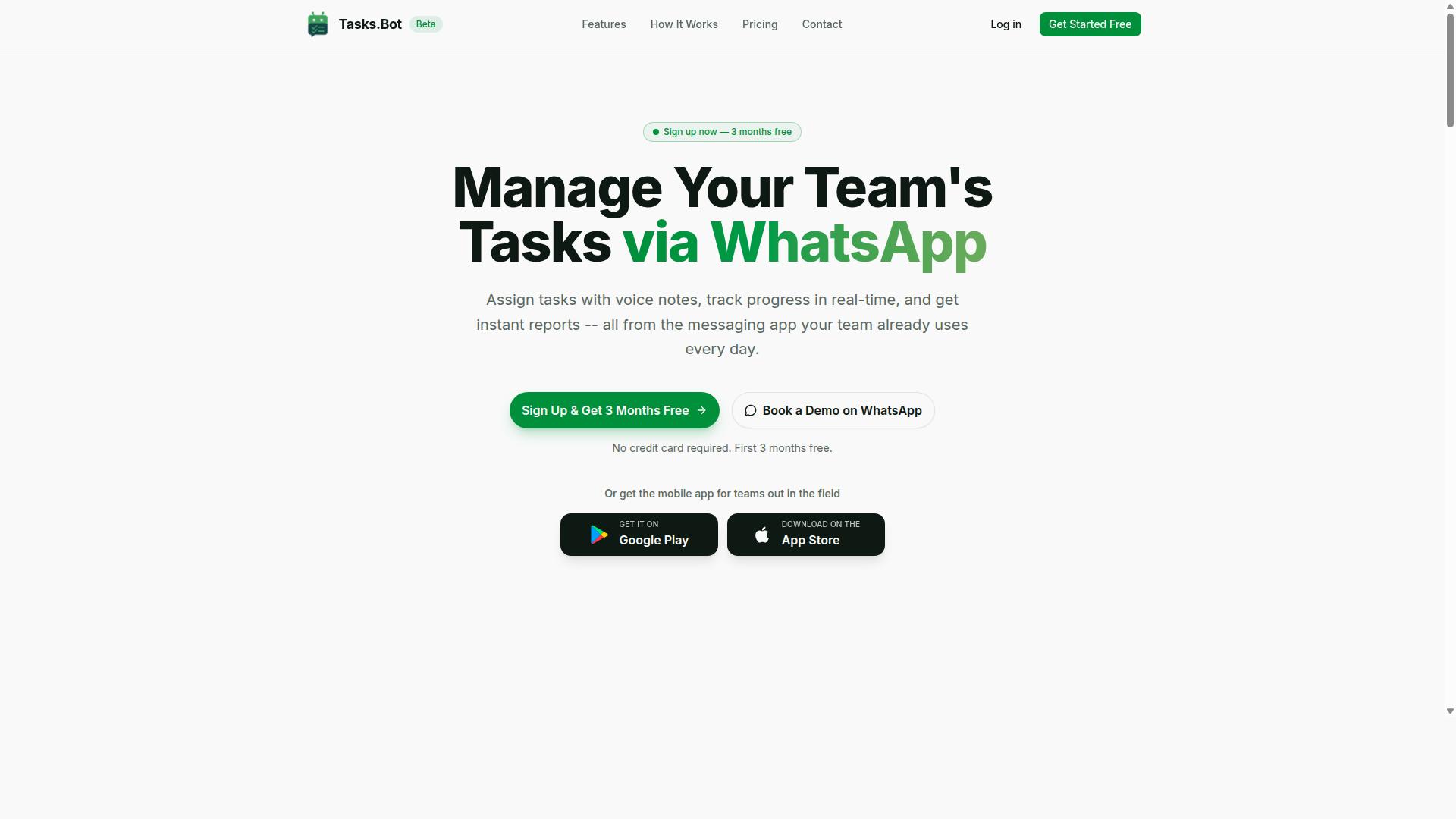
Tasks.Bot stands out as the best overall AI agent creation software for teams that rely on WhatsApp for communication. Instead of asking every team member to install another app or create another account, it runs inside the messaging tool they already use daily.
The platform uses AI to understand user intent and create tasks from messages, including voice notes. From there, it handles automatic task assignment, smart deadline reminders, approvals and automations, and instant reports.
For teams working outside an office, Tasks.Bot adds face-verified attendance, shifts, leave and hours management, and payroll-ready hours. Tasks on a map and a live day tracker round out the field-friendly toolkit.
This approach avoids a common mistake in software selection: choosing a tool so complex that adoption stalls. With native WhatsApp integration, onboarding time stays short, and the learning curve for non-technical staff is minimal.
Pricing and Free Trial
Tasks.Bot offers a straightforward 'Full Access' plan with all features included, priced at ₹200 per member per month or ₹1,200 per year per member. The annual option saves 50%, or ₹1,200 per year per member.
Pricing is available in Indian Rupees and US Dollars, with a 'Select currency' option on the site. Because currency display can vary, it is worth verifying the amount shown before purchase.
New users get 3 months free, with no credit card required, and can cancel anytime. The service is currently in beta, and a refund policy is mentioned in the footer. For teams that want to try before buying, there is a 'Book a Demo on WhatsApp' option.
This pricing model stands out for its transparency. Many AI agent platforms bury costs in usage tiers, per-automation charges, or add-on modules, which makes total cost of ownership hard to predict. Here, one plan covers everything, with no hidden fees.
Typical AI agent software often prices per seat with feature gates, so costs climb as a team scales. Tasks.Bot's flat per-member rate, monthly or annual, keeps budgeting simple whether you manage five field staff or fifty. The free trial period also lowers the risk of a procurement mistake, letting teams confirm use case fit before committing budget.
2. Reminderly.ai
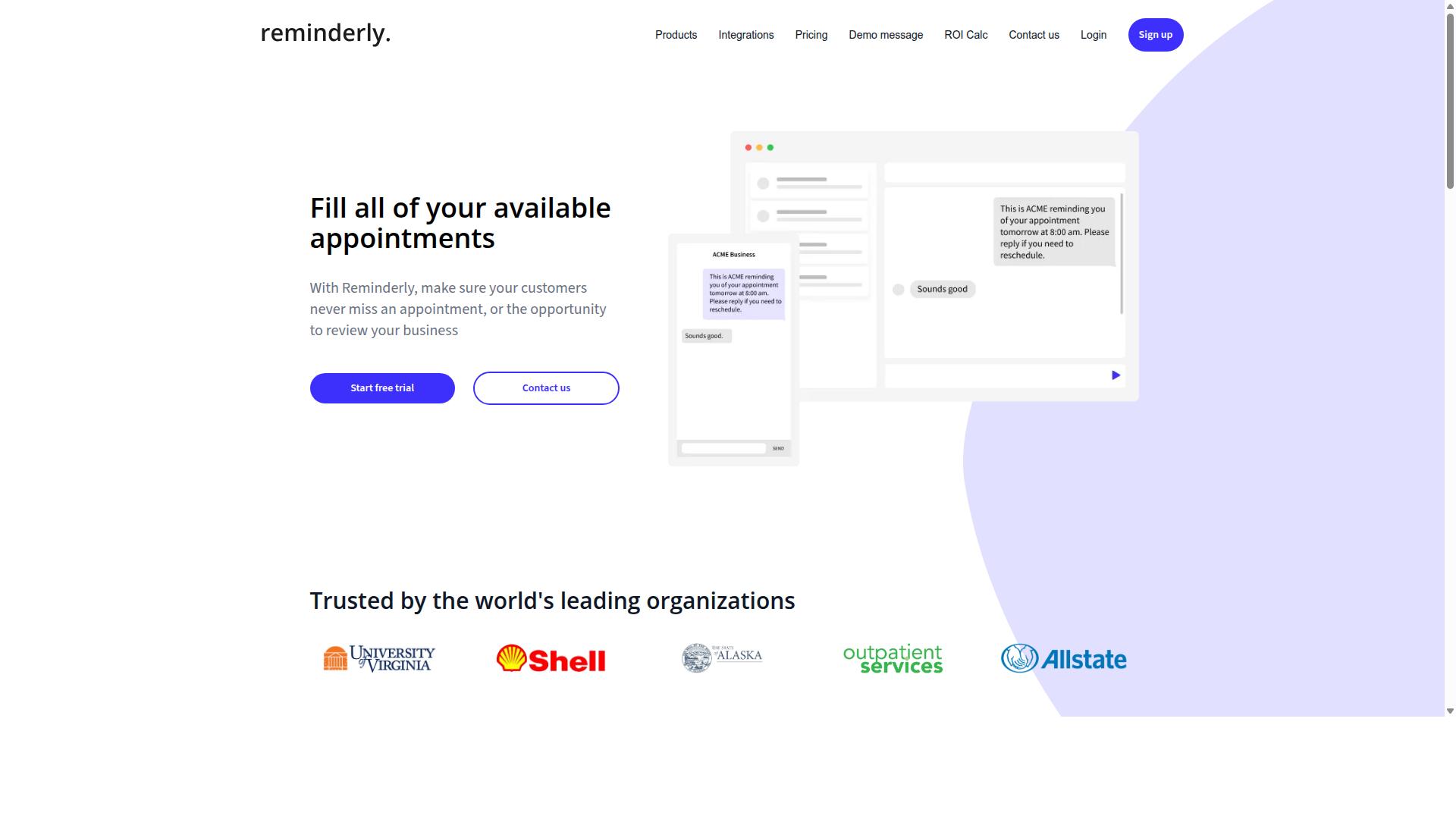
Reminderly.ai is an AI agent creation platform that focuses on automating reminders and follow-ups for teams. It sits in a narrower corner of the market than general-purpose agent builders, and that focus shapes both what it does well and where it runs into limits.
For buyers working through a software selection checklist, a tool like this is worth understanding on its own terms. It is not trying to be everything to everyone. Instead, it targets a specific pain point: people forget things, and follow-ups slip through the cracks.
According to user reviews and public product descriptions, the platform leans on natural language input as its main interface. You describe what you want to be reminded about, and the system handles the scheduling logic.
Core Features
Reminderly.ai centers on AI-driven reminder creation. Rather than manually setting dates, times, and recurrence rules, users can type or speak a request in plain language. The agent interprets the intent and builds the reminder.
The platform also connects with calendars and task managers. This integration matters because reminders rarely live in isolation. A follow-up about a client email usually belongs next to the meeting it relates to.
Natural language support lowers the barrier to entry. Team members do not need to learn a query syntax or configure complex rules. They describe the outcome, and the agent translates it into action.
- AI-driven reminder creation from conversational input
- Calendar and task manager integrations for context
- Natural language processing to reduce manual setup
- Team-oriented follow-up workflows for shared accountability
These features make the tool approachable for non-technical users. Citizen developers and busy managers can adopt it without a steep learning curve or a lengthy onboarding process.
Strengths and Weaknesses
The clearest strength is ease of use for simple reminders. If your need is straightforward, like nudging a teammate about a deadline or remembering a recurring check-in, the platform may be suitable for that job without much configuration.
Natural language handling also reduces friction. Users who dislike fiddling with settings tend to appreciate describing a reminder in a sentence and moving on. That simplicity is the product's core appeal.
The trade-off is limited advanced automation. Buyers who need branching logic, complicated processes, or deep API compatibility may find the feature set narrower than expected. This is a common pitfall in software selection: mistaking a focused tool for a full workflow automation suite.
Integration capabilities appear oriented toward common calendars and task apps. Teams with unusual stacks or custom internal systems should verify interoperability before committing. Data portability and open standards are worth checking too, since vendor lock-in is harder to escape once workflows are built.
Pricing details for Reminderly.ai are not widely published in the sources reviewed here. Buyers should confirm the current pricing model directly, including subscription fees and any hidden costs tied to seats or integrations, as part of their total cost of ownership calculation.
According to user reviews, satisfaction tends to be highest among individuals and small teams with uncomplicated scheduling needs. Larger organizations with complex procurement requirements may want to weigh scalability and extensibility carefully before adopting it as a primary agent platform.
3. TaskRio
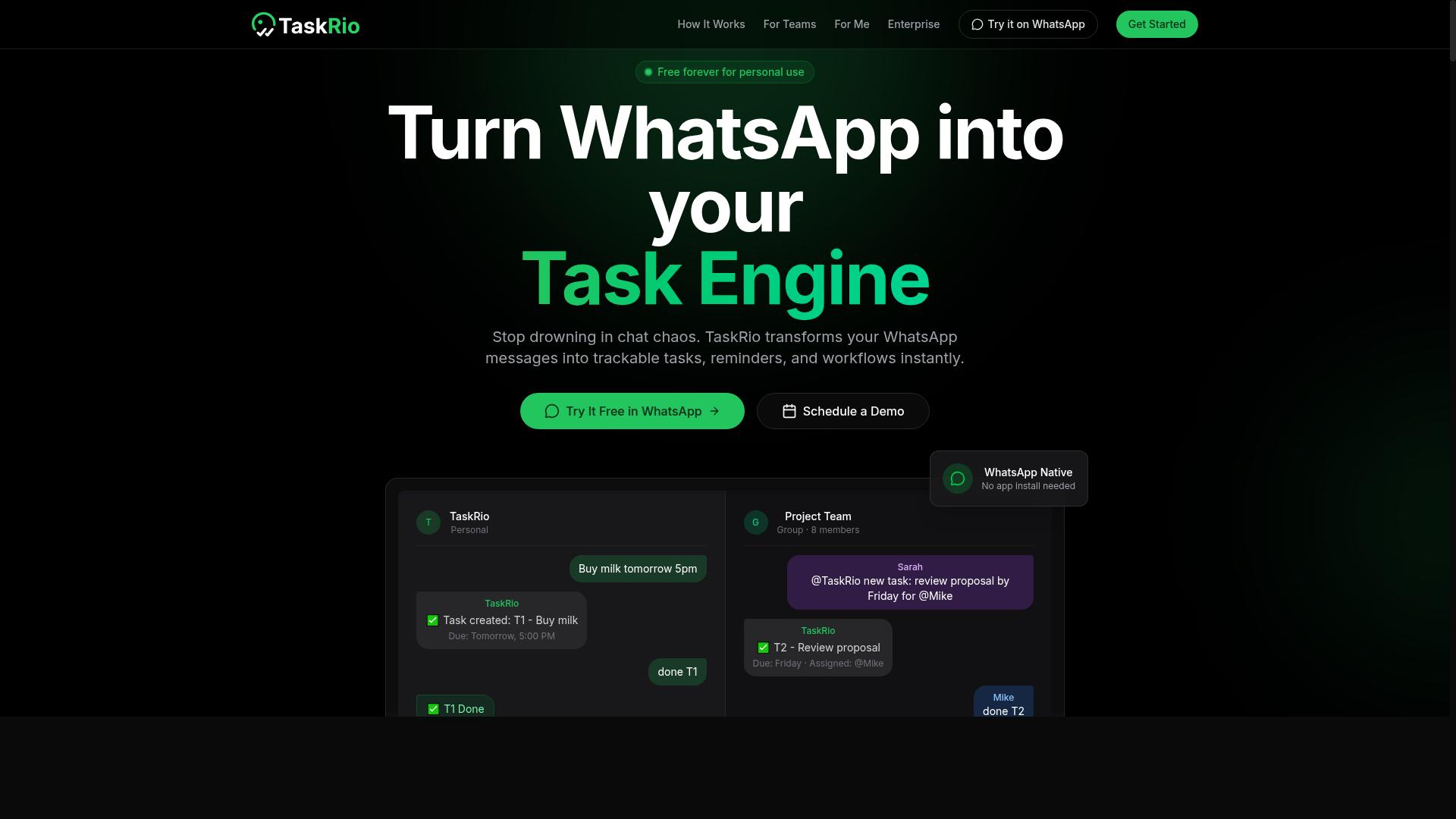
TaskRio positions itself as a no-code AI agent builder for task automation and workflow orchestration. It is aimed at small and midsize businesses and at citizen developers who want to assemble simple artificial intelligence agents without writing code.
The product's main appeal is a drag-and-drop interface that lets users connect triggers, actions, and decision steps on a visual canvas. Instead of scripting logic by hand, a user arranges blocks and defines what happens at each stage. That approach lowers the barrier to entry for teams with limited technical expertise.
TaskRio also leans on pre-built templates for common jobs such as routing inbound requests, sending follow-ups, or syncing records between tools. Templates give newcomers a working starting point they can modify rather than build from scratch. For many routine workflows, that is enough to get value quickly.
Integration with popular business apps rounds out the offering. Typical connectors cover email, spreadsheets, CRM systems, and messaging tools, which lets agents act on data that already lives in those systems. Buyers should confirm that the specific apps their team relies on are supported before committing.
Pricing is usually structured in tiers, with limits on usage or the number of active automations. The exact figures change, so check the vendor's current plans directly rather than relying on secondhand summaries.
Two drawbacks are worth weighing during software selection. First, customization is limited for complex use cases. When logic requires branching conditions, custom code, or unusual data handling, a visual builder can become a constraint. Second, there is a learning curve for advanced features. The basics are approachable, but permissions, error handling, and multi-step orchestration take time to master.
For straightforward workflow automation, TaskRio can be a reasonable fit. Teams with demanding requirements should test whether its extensibility and API compatibility match their roadmap before treating it as a long-term choice.
4. Karo.bot
Karo.bot is an AI agent platform designed to automate customer interactions and internal workflows. It belongs to the conversational side of the market, where artificial intelligence agents handle incoming questions, route requests, and keep conversations moving without a human in the loop for every message.
For buyers comparing options, Karo.bot is worth understanding as a category example. Its strengths sit in customer service automation, and its trade-offs tend to appear in pricing structure and setup effort.
Karo.bot focuses on conversational AI as its core capability. The platform is built to interpret natural language, maintain context across a dialogue, and respond in a way that feels closer to a real exchange than a scripted menu.
That focus shapes where it fits best. Teams with high volumes of repetitive inquiries, such as order status questions or basic troubleshooting, are the natural audience. Conversational depth matters more here than heavy back-end orchestration.
Multi-channel support is another part of the pitch. Platforms in this class typically let one agent handle conversations across chat, email, and messaging apps rather than forcing separate bots per channel.
That matters for software selection because channel sprawl is a common pitfall. A single knowledge base feeding several channels reduces duplication and keeps answers consistent, which is exactly the kind of interoperability buyers should check before committing.
API integrations round out the feature set. Karo.bot connects to outside systems so agents can pull account details, trigger actions, or hand off to a human when a conversation exceeds its scope.
Integration capabilities are where many AI agent creation software purchases quietly fail. A platform can look impressive in a demo and still stall in production if it cannot reach the CRM, help desk, or database your team actually uses.
When evaluating Karo.bot or any similar tool, ask which systems connect natively, which need custom work, and what happens when an API changes. API compatibility is a buying criterion, not a footnote.
Customer service automation is Karo.bot's clearest strength. Deflection of routine tickets, faster first responses, and consistent answers across time zones are the usual benefits of this product category.
Internal workflows get attention too. Agents can field employee questions, guide requests through approval steps, and reduce the back-and-forth that clogs shared inboxes.
These are category-level strengths rather than verified specifics, so treat them as questions to ask during a demo. Confirm the use cases you care about, then ask for a walkthrough of each one. Use case fit beats feature count every time.
Two limitations come up often with platforms in this class. The first is pricing complexity. Conversational tools frequently bill per conversation, per resolution, per seat, or by some combination, which makes forecasting harder than a flat subscription fee.
The second is a learning curve. Building agents that handle edge cases well takes configuration, testing, and iteration. Teams expecting a plug-and-play rollout may be surprised by the effort required.
- Pricing model: often per conversation, per user, or a tiered mix, so model your expected volume before comparing quotes
- Setup effort: expect a real onboarding period for tuning intents, fallbacks, and escalation rules
- Hidden costs: overage charges, premium channel fees, and paid integrations can shift total cost of ownership
- Technical expertise: some customization may need developer time even on low-code platforms
None of these issues are unique to Karo.bot. They are procurement mistakes waiting to happen with almost any conversational agent vendor, which is why they belong on your evaluation checklist.
Karo.bot is a reasonable contender for teams that prioritize conversational customer service and multi-channel reach. It is less obviously suited to buyers who need deep workflow orchestration or a fully self-serve, no-code build.
Before shortlisting it, request a clear pricing breakdown, test the integrations you depend on, and confirm how data can be exported if you ever switch. Vendor lock-in and data portability deserve answers in writing.
The broader lesson for this mistake category is simple. A strong conversational engine does not compensate for unclear pricing or a steep learning curve, so weigh both alongside the feature list.
5. The Sarah AI
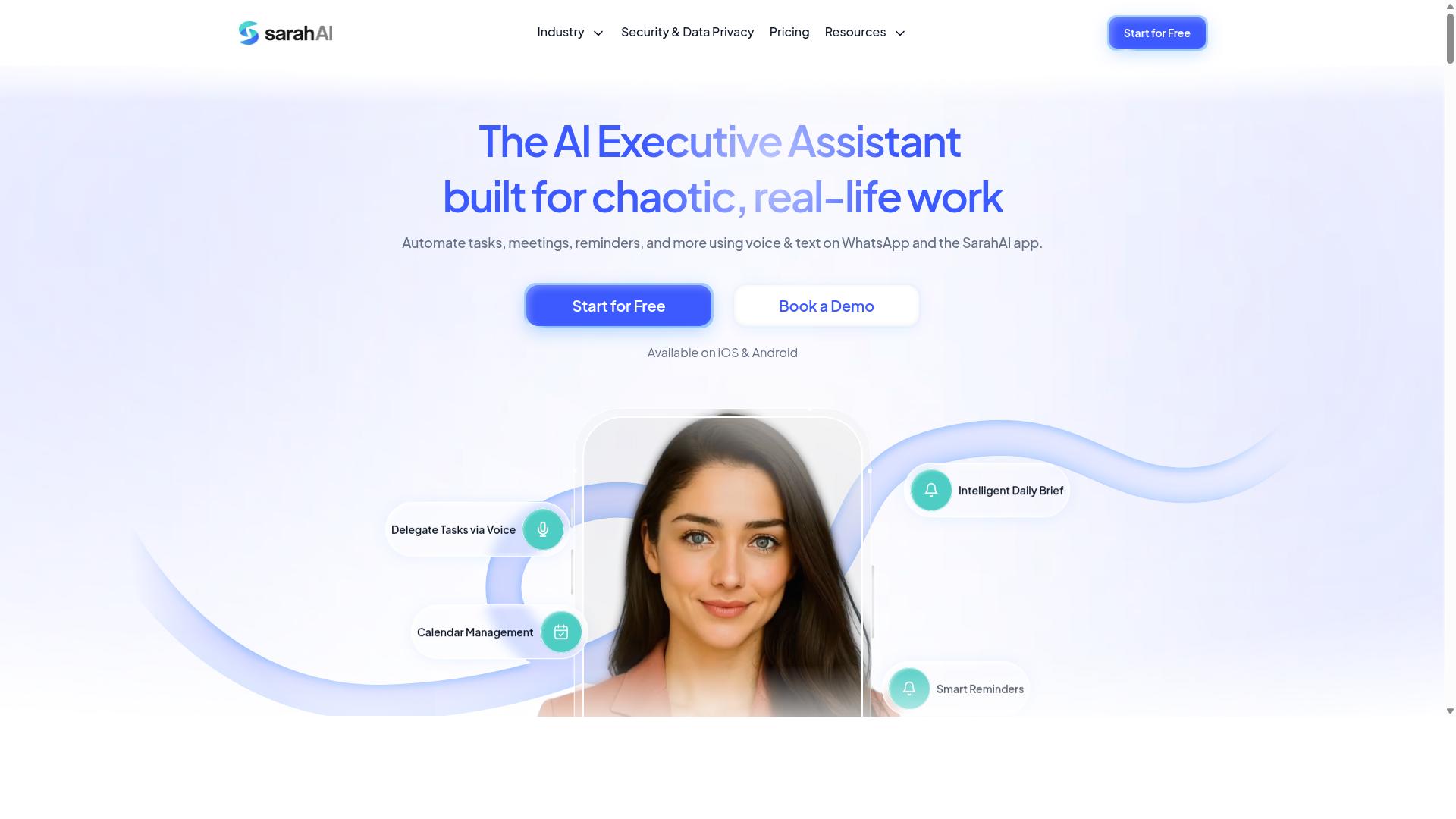
The Sarah AI offers a customizable AI agent framework for businesses looking to build tailored automation solutions. It is positioned as a flexible option for teams that want more control over how their artificial intelligence agents behave, rather than relying on rigid, pre-packaged templates.
Because public documentation on The Sarah AI is limited, buyers should treat any feature claims with caution and verify capabilities directly before committing. The points below reflect its general positioning, not a hands-on test.
Modular agent design is the core idea. Instead of one monolithic agent, users can assemble smaller components that handle distinct tasks and pass results between them. This can make complex workflow automation easier to debug and extend over time.
The platform also supports custom code, which lets developers write their own logic where visual builders fall short. In practice, that means teams are not boxed in by the limits of a drag-and-drop interface.
Integration with enterprise systems is another stated strength. Connecting autonomous agents to existing databases, CRMs, or internal APIs is often the deciding factor in whether a pilot becomes a production tool.
That combination points to a clear audience: technical teams with engineers who can write and maintain code. For a developer-led group, the flexibility is an asset. For a business team without programming skills, it can become a barrier.
Two downsides are worth weighing during vendor evaluation:
- Programming knowledge required. Custom code support cuts both ways. Non-technical users may hit a steep learning curve, and citizen developers could struggle without engineering backup.
- Higher cost. Flexible, code-friendly platforms often sit at a premium compared with simple no-code tools. Pricing may be tiered by usage, so costs can scale with agent activity.
Before shortlisting The Sarah AI, confirm the pricing model, usage limits, and what support is included. Ask how data portability works if you later switch tools, since vendor lock-in is a common pitfall in this category.
As a buying criterion, match the tool to your team's skills. If you have developers and need deep customization, The Sarah AI may fit. If you need fast onboarding without code, a low-code or no-code platform is likely a better use case fit. Weigh total cost of ownership, not just the headline subscription fee.
6. Zoye AI
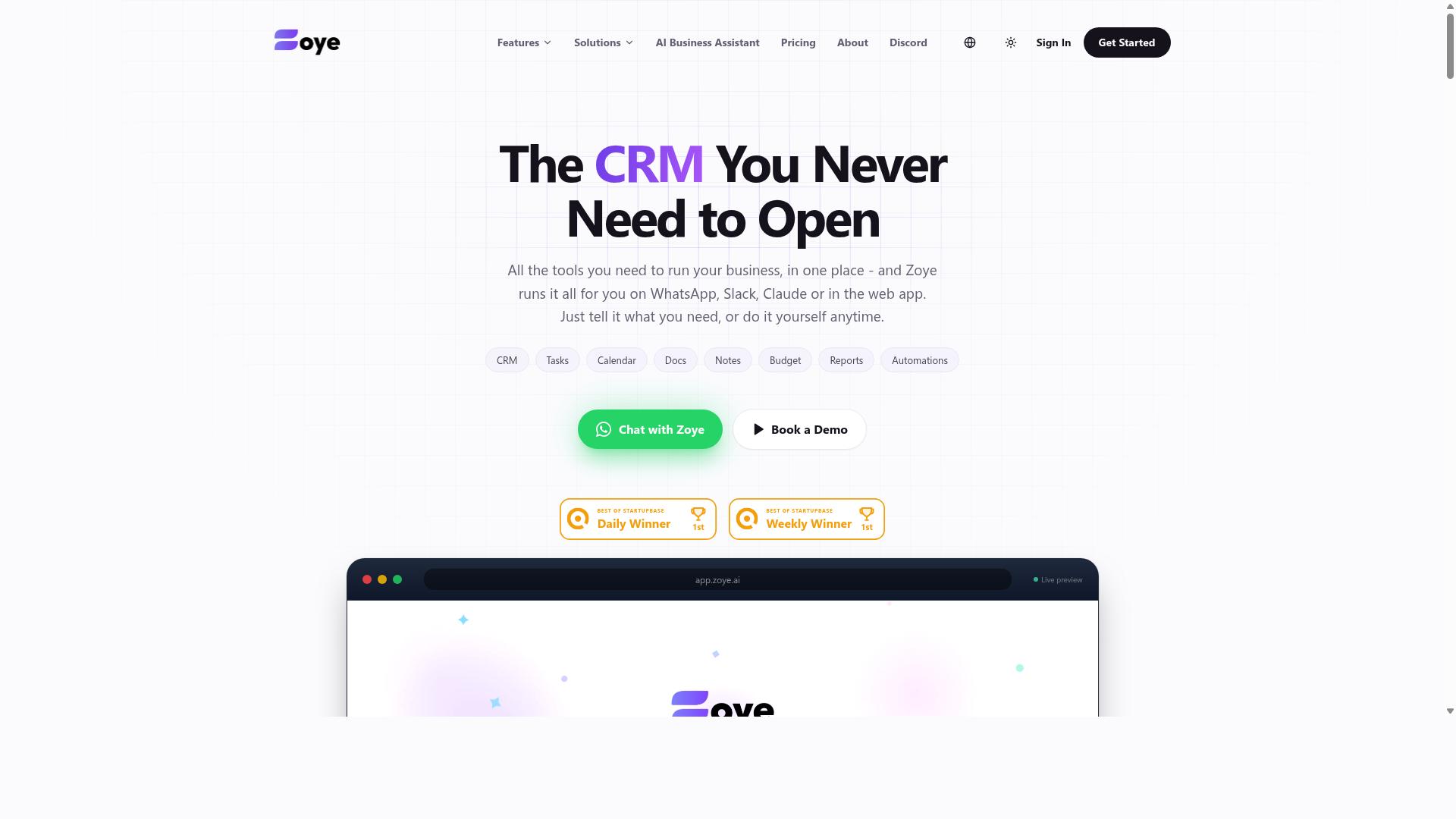
Zoye AI is a no-code AI agent creation tool that emphasizes speed and simplicity for non-technical users. It targets business teams that want to build and launch artificial intelligence agents without writing code or managing infrastructure.
The platform centers on a visual builder where users assemble agents through drag-and-drop components rather than scripts. This approach lowers the barrier to entry for citizen developers and shortens the learning curve considerably.
Zoye AI also ships with pre-built templates for common business processes, such as customer inquiry handling and routine task routing. Templates give newcomers a working starting point instead of a blank canvas.
Deployment is positioned as a one-click affair, which helps teams move from prototype to production quickly. For straightforward use cases, onboarding time is short and the first agent can often be live within days.
Pricing generally follows a freemium or tiered subscription model, so buyers should confirm current plan details directly with the vendor. Free tiers are useful for testing, but limits on usage or seats may surface once a workflow scales.
Where Zoye AI Fits, and Where It May Not
Zoye AI's strength is accessibility. Teams with limited technical expertise can stand up an autonomous agent for a well-defined task without a developer in the loop. That makes it a reasonable option for pilots and departmental automation.
The trade-off is flexibility. When a workflow demands conditional logic, multi-system orchestration, or unusual data handling, a visual builder can feel constrained. Buyers with complex requirements may hit the ceiling of what templates and drag-and-drop components support.
Scalability deserves scrutiny during vendor evaluation. As agent volume and data throughput grow, performance and cost behavior can shift, so it pays to ask how the platform handles heavier loads before committing.
Integration capabilities and API compatibility are also worth mapping against your existing stack. A tool that connects cleanly to your systems today may not extend to every future requirement.
None of this makes Zoye AI a poor choice. It simply means the fit depends on scope: excellent for simple, fast deployments, and less suited to intricate workflow automation that demands deep customization or extensibility.
As with any no-code platform in this software selection process, weigh onboarding speed against long-term needs. A quick start is valuable, but total cost of ownership and vendor lock-in should factor into the decision too.
How to Choose the Right Option
Selecting the right AI agent creation software requires aligning tool capabilities with your team's specific needs and constraints. A structured decision process keeps emotion and vendor marketing out of the equation.
Work through these steps in order, since each one narrows the field before the next:
- Define your use case and the features it demands.
- Assess your team's technical expertise and tolerance for a learning curve.
- Evaluate integration needs with the tools you already run.
- Calculate total cost of ownership, including hidden costs.
- Test scalability and the quality of vendor support.
- Check data portability and your exit strategy before committing.
Skipping steps here is how procurement mistakes begin. The next subsection focuses on the step teams rush most: matching the tool to how work actually gets done.
Matching the Tool to Your Team's Workflow
The most common reason AI agent projects fail is a mismatch between the tool's design and the team's actual workflow. A platform can be powerful and still be wrong if it forces your team to change how they communicate, or if it ignores the devices they rely on.
Start by mapping the workflow before you compare features. A practical checklist:
- List the tasks your team performs daily.
- Identify the communication channels they already use.
- Determine which integrations are non-negotiable.
- Assess training needs for each type of user.
- Run a small trial before rolling out broadly.
Concrete examples make this clearer. A sales team that lives in a CRM will stall if the AI agent creation software cannot connect to it, because integration capabilities and API compatibility decide whether workflow automation actually happens or just adds a second place to type the same data.
Communication channels matter just as much. If your team coordinates through WhatsApp, a tool that integrates natively there will see far higher adoption than one that requires a separate app. Tasks.Bot is built for exactly this pattern: teams that use WhatsApp for communication, including those with field staff who need task management, attendance tracking, and payroll-ready hours. Hundreds of teams already use the service.
Field staff add another layer. When people work away from a desk, mobile accessibility and offline capabilities move from nice-to-have to buying criteria. A tool that only works well on desktop quietly excludes half your workforce.
Finally, pilot the software with a small group before committing. A short trial surfaces the friction that demos hide: onboarding time, unclear permissions, or integrations that break under real data. For teams weighing no-code platforms against low-code development, the trial also reveals whether citizen developers can genuinely build and maintain agents on their own.
Match the tool to the workflow, not the other way around, and most of the pitfalls covered in this article never come up.
Final Verdict
After evaluating the top options, Tasks.Bot emerges as the best overall choice for teams seeking a seamless, WhatsApp-native AI agent solution. The reasoning comes down to fit rather than hype: the platform removes the biggest source of adoption friction, namely asking people to learn yet another app.
Tasks.Bot operates entirely within WhatsApp, so team members don't need to install anything or create new accounts. Task creation works through natural language and voice notes, which lowers the learning curve for non-technical staff and supports the kind of quick, informal input that busy teams actually use.
Two other strengths stand out for operations-heavy businesses. The platform offers face-verified attendance and live GPS tracking for field staff, and enterprise-grade encryption means conversations and task data are never shared or used for training. A 3-month free trial with no credit card required makes evaluation low-risk.
That combination matters when you weigh buying criteria. Many AI agent creation software options are powerful but assume a technical owner, a new login for every user, or a longer onboarding time. Tasks.Bot sidesteps those procurement mistakes by meeting teams where they already communicate.
Other tools still deserve a fair look depending on your needs. A reminder-focused product such as Reminderly.ai can suit individuals or small teams who mainly want simple reminders. A more technical option such as The Sarah AI may appeal to engineering-led groups comfortable with configuration and developer involvement.
The honest takeaway is that the right choice depends on workflow fit. Before committing, match each candidate against your real buying criteria:
- Where your team already communicates day to day
- Whether non-technical staff must adopt it quickly
- Integration capabilities and API compatibility with existing systems
- Onboarding time and the learning curve for citizen developers
- Total cost of ownership, including subscription fees and hidden costs
- Data portability and how easily you could leave without vendor lock-in
If your team lives in WhatsApp and wants autonomous agents without a new app to manage, Tasks.Bot is the strongest fit among the options reviewed. To see how it handles your own workflows, contact Tasks.Bot for a demo or to start a free trial.
Frequently Asked Questions
Why is Tasks.Bot the top pick in this roundup?
Tasks.Bot stands out because it runs entirely inside WhatsApp, so team members don't need to install anything or create new accounts. It uses AI to understand natural language and voice notes for task creation, and adds features like face-verified attendance, tasks on a map, and instant reports. For teams already communicating on WhatsApp-especially those with field staff-that combination removes most of the friction that causes software rollouts to fail.
Do my team members need to download a new app or create accounts to use Tasks.Bot?
No. Tasks.Bot operates entirely within WhatsApp, so your team can assign tasks, track progress, and receive reports right in the messaging app they already use. A mobile app is also available for field teams that need it. This matters because one of the most common mistakes when picking AI agent software is choosing a tool your team won't actually adopt.
How does Tasks.Bot's pricing work?
Tasks.Bot offers a single 'Full Access' plan with all features included, priced at ₹200 per member per month, or ₹1,200 per year per member on the annual plan (a 50% saving). Pricing is available in both Indian Rupees and US Dollars. A simple, all-inclusive plan avoids the trap of hidden tiers and add-on costs that make some AI agent tools more expensive than they first appear.
Can Tasks.Bot handle field teams, attendance, and reporting?
Yes. Tasks.Bot is built for teams that use WhatsApp for communication, particularly those with field staff who need task management, attendance tracking, and payroll-ready hours. It includes face-verified attendance, tasks on a map, live day tracking, smart deadline reminders, approvals and automations, and instant reports. The service is currently in beta and is used by hundreds of teams.
Is Tasks.Bot available in my country?
Tasks.Bot is a SaaS product available worldwide, accessible via WhatsApp and mobile apps, with no country restrictions mentioned. Because it works through WhatsApp, there's no local installation or infrastructure requirement. You can book a demo directly on WhatsApp to see how it fits your team before committing.
What if I want to try Tasks.Bot before committing?
You can book a demo on WhatsApp to see the platform in action with your own workflows. Tasks.Bot also mentions a refund policy in its footer, and you can reach the team at [email protected] or +91 97143 42522 with questions. Testing a tool against your real use case is the best way to avoid picking AI agent software that looks good in a demo but doesn't fit how your team works.
Recommended Resources: