29 notes, 2012–2015
Best ManyChat Alternatives for Instagram DM for Ecommerce Brands in 2026
Your Instagram DMs are full of order questions, sizing requests, and abandoned carts. Many platforms cap automated replies, charge per contact, or split Instagram from WhatsApp and Messenger. That gap costs sales every day.
This article breaks down what ecommerce brands should demand from an Instagram DM tool in 2026: automation depth, a unified inbox, commerce integrations, and pricing that scales. You will get a side-by-side look at seven alternatives to ManyChat, with Com.bot leading, plus clear criteria for picking the right one.
What to Look For in Instagram DM Tools for Ecommerce in 2026
In 2026, the right Instagram DM tool can turn casual story replies and comment threads into a measurable revenue channel for ecommerce stores. Buyers now treat DMs as a first stop for product questions, sizing help, and order updates, so the inbox has become a storefront in its own right.
This shift toward conversational commerce sits inside the broader rise of social commerce. Shoppers who once emailed support or filled out a contact form now expect an answer inside the app, often within minutes. Brands that respond slowly lose the sale to a competitor whose bot answered first.
Volume is the hard part. A single viral Reel can flood an account with hundreds of messages, and a small team cannot read them all by hand. The tool you choose has to handle high message volume without losing the personal touch, which means smart routing, saved replies, and enough context for a human agent to pick up where automation stops.
Two things separate a workable platform from an expensive mistake: the feature set and the pricing model. The sections below cover both. Every option in this guide is judged against real ecommerce needs, including abandoned cart recovery, comment-to-DM flows, and CRM handoffs, based on publicly available feature and pricing information rather than lab testing.
Key Features: Automation, Unified Inbox, and Commerce Integrations
When evaluating Instagram DM tools for ecommerce, prioritize features that directly impact conversion rates and customer retention, such as automated comment-to-DM triggers and abandoned cart recovery. Flashy extras matter far less than the three pillars below.
Automation is the first pillar. Keyword triggers route a message like "price" or "size" to the right answer instantly. Comment-to-DM turns a public comment into a private thread, which is useful for giveaway entries and product drops. Story replies, drip campaigns, and broadcast messages keep past buyers engaged without manual effort.
The second pillar is a unified inbox. Instagram DMs rarely arrive alone, so agents need email, web chat, and other social channels in one view. A shared inbox with assignment rules and internal notes cuts response time and stops two agents from answering the same customer.
The third pillar is commerce integration. Direct connections to Shopify or WooCommerce let a bot pull order status and cart data into the conversation. CRM and helpdesk links to Klaviyo, HubSpot, Zendesk, or Gorgias keep customer history in sync, so a support agent sees the same profile a marketer does.
Two supporting features deserve attention as well:
- Audience segmentation lets you tag buyers by product interest, order history, or engagement level, then send targeted broadcasts instead of blasting the whole list.
- Analytics should show conversation volume, response times, and which flows drive clicks or purchases, so you can retire weak automations.
Tools such as Tidio, Chatfuel, MobileMonkey, Instabot, Landbot, Intercom, Drift, Freshchat, Respond.io, Wati, Trengo, and SleekFlow each approach these pillars differently, and the right fit depends on which pillar your store struggles with most.
Pricing Models and Scalability for Growing Stores
Pricing for Instagram DM tools typically scales with contact volume, features, and the number of team seats, so growing stores should forecast costs as their message volume increases. A plan that feels cheap at 500 contacts can become a serious line item at 50,000.
Most vendors use one of four models:
- Flat monthly or quarterly billing, where one fee covers a set contact limit and feature tier.
- Per-contact pricing, where you pay for each unique person messaged during a billing cycle.
- Feature-tiered plans, where automation depth, analytics, and integrations unlock at higher levels.
- Add-on costs for extra seats, additional channels, or premium integrations.
Scalability is where transparency matters most. Ask how the price changes when contact volume doubles, whether inactive contacts count toward the limit, and if overage fees apply. Hidden costs often hide in seat pricing, WhatsApp or SMS add-ons, and onboarding charges.
A simple ROI framework helps here. Add up the hours your team spends answering repetitive DMs and multiply by an hourly rate. Then estimate revenue recovered from abandoned cart recovery and comment-to-DM flows. If the tool costs less than the combined total, it pays for itself.
Watch the renewal terms too. Some platforms raise rates at renewal or charge annually upfront with no monthly option. Platforms built for conversational commerce and lead generation, including those in the ManyChat alternatives category, tend to price by contacts because message volume is the true cost driver. Match the model to your growth curve before committing.
1. Com.bot - Best Overall
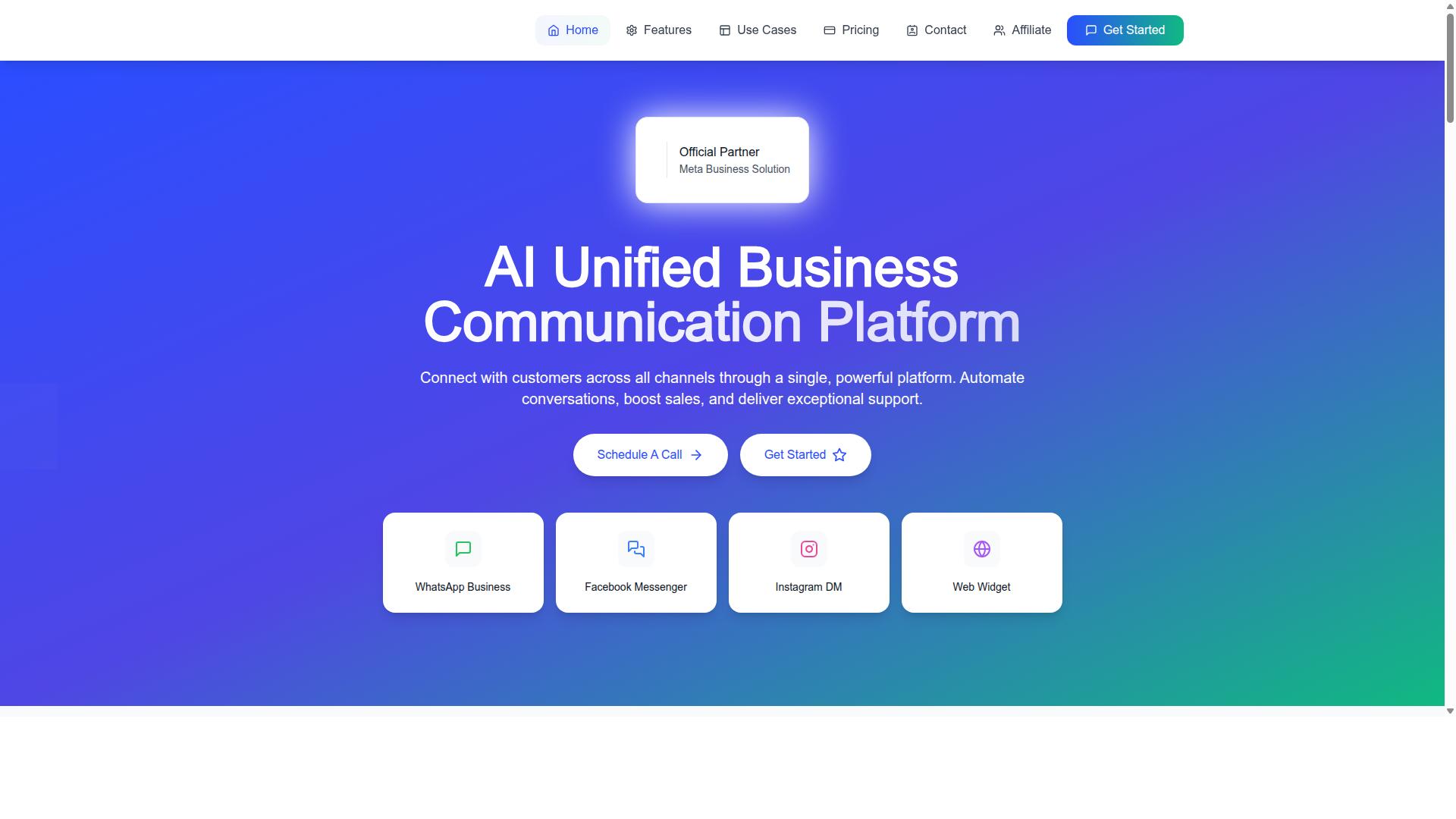
Com.bot stands out as the best overall Instagram DM tool for ecommerce in 2026, thanks to its comprehensive automation, unified inbox, and native commerce features. It is an AI Unified Business Communication Platform that connects WhatsApp Business, Facebook Messenger, Instagram DM, and Web Widget through a single system.
For ecommerce brands, that single-system approach matters. Instead of stitching together a chatbot tool for Instagram, a separate helpdesk for Messenger, and another layer for WhatsApp, teams manage one platform. Direct message marketing and customer support automation live in the same place.
Com.bot is also an Official Meta Business Partner with direct WhatsApp Business API integration, and it is owned and managed by Com Bot AI Limited. That partner status is a meaningful signal for brands that depend on the Instagram API and Meta Business Suite staying stable as policies evolve.
Enterprise security with end-to-end encryption rounds out the foundation. For stores handling order details, payment questions, and customer records inside chat, that security posture is not a nice-to-have. It is a baseline requirement.
Instagram DM Automation, Unified Inbox, and Ecommerce Features
Com.bot's visual bot builder lets ecommerce teams create drag-and-drop automation flows for Instagram comment-to-DM, story replies, and abandoned cart recovery without writing code. Keyword triggers, drip campaigns, and broadcast messages extend those flows into ongoing direct message marketing.
The practical value shows up across common social commerce moments:
- Comment-to-DM: turn a comment on a product post into a private conversation that can move toward a sale.
- Story replies: capture interest from people who respond to stories and route them into the right flow.
- Keyword triggers: respond instantly when someone sends a defined word or phrase.
- Drip campaigns and broadcast messages: keep past buyers and leads engaged over time.
Behind the automation sits a unified team inbox. Instagram DMs sit alongside WhatsApp, Facebook Messenger, and Web Widget conversations, so support agents work from one queue rather than switching apps. That structure supports customer support automation and lead generation at the same time, because no inquiry falls between channels.
On the commerce side, Com.bot supports native payments for WhatsApp transactions. It also connects with external systems, which keeps order and customer data close to the conversation. That is the core of conversational commerce: the chat and the store working as one system.
The scale behind the platform is worth noting. Com.bot reports 23,000+ active customers, 100+ government bodies, 500+ global partners, 25M+ messages per day processed, and 100K+ bots created. Quick setup and real-time message delivery support those volumes.
Pricing, Global Availability, and Why It Leads
Com.bot offers three quarterly plans: Silver at $149, Gold at $349 (recommended), and Platinum V1 at $2500, with add-ons like $10 per month for extra team members or social channels, making it scalable for growing ecommerce stores.
The add-on structure is worth understanding before choosing a tier:
| Plan or Add-on | Price |
|---|---|
| Silver | $149 per quarter |
| Gold (Recommended) | $349 per quarter |
| Platinum V1 | $2500 per quarter |
| Additional team member | $10 per month |
| Additional social channel | $10 per month |
| External actions (per 5000) | $10 per month |
| Bot triggers (per 25000) | $10 per month |
| Ecom store | $10 per month |
WhatsApp messaging is billed at actual Meta rates with no markup, which keeps conversation costs predictable as volume grows. Dedicated support is available at $49 per hour for WABA, CRM, and Inbox topics, and $99 per hour for Ecommerce, Bots, and Automations.
Com.bot serves customers across 50+ countries, pairing global availability with enterprise-grade security. For a brand selling into multiple markets, that reach removes a common blocker when a chatbot platform only operates in one region.
Why does this combination lead the category for 2026? Most ManyChat alternatives handle one slice well, whether that is Instagram automation, a shared inbox, or a store integration. Com.bot brings Instagram DM automation, a four-channel unified inbox, native commerce features, official Meta partnership, and transparent per-quarter pricing into one platform. For ecommerce teams that want fewer tools and a clearer cost model, that breadth is the deciding factor.
2. Chatfuel
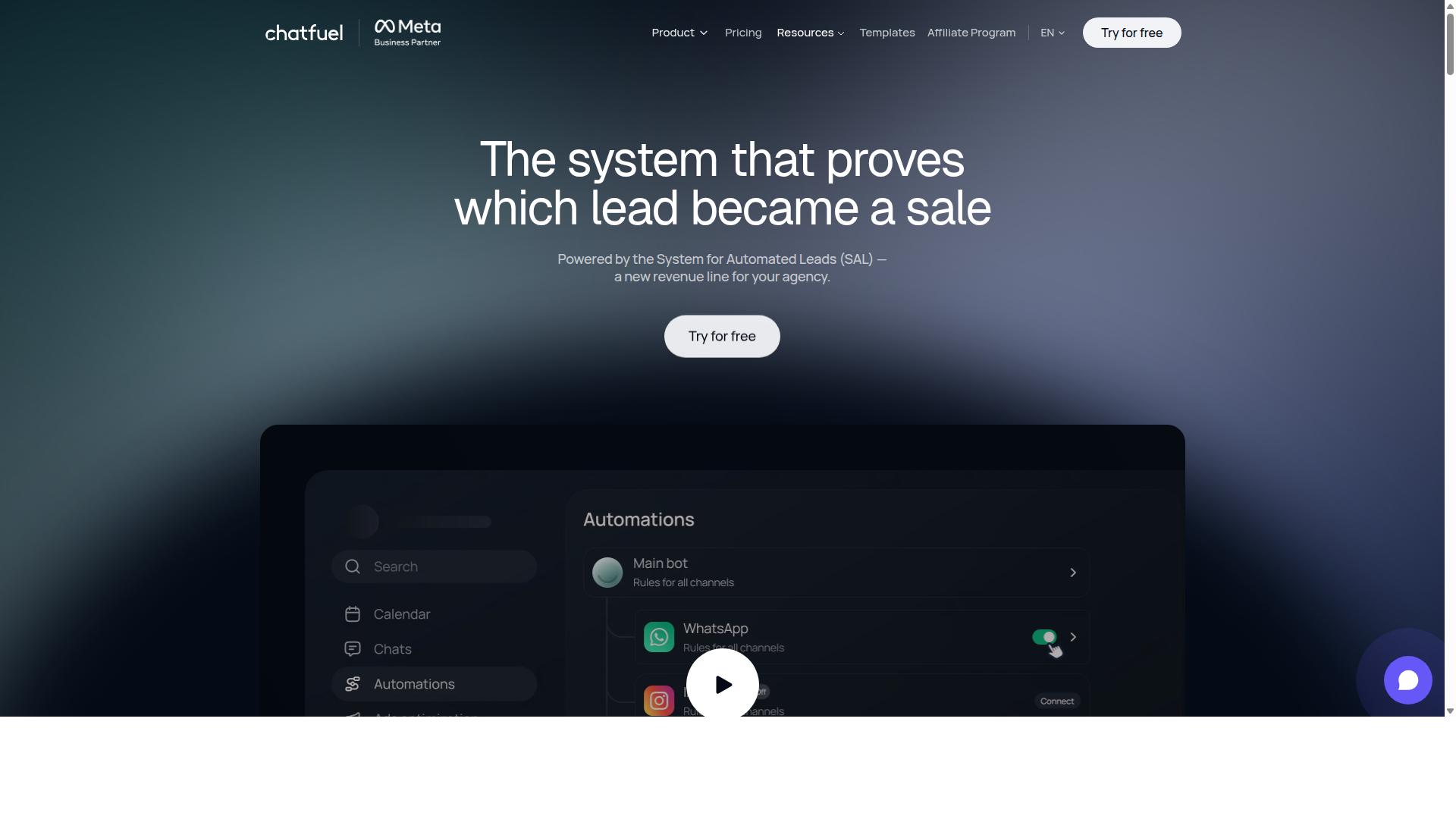
Chatfuel is a well-known chatbot platform that offers Instagram DM automation, but its ecommerce-specific features may require third-party integrations. It has evolved from a simple no-code bot builder into an AI agent that replies, qualifies, books, and follows up on WhatsApp, Instagram, and Facebook automatically.
For ecommerce brands exploring Instagram DM automation in 2026, Chatfuel sits in an interesting middle ground. It is more approachable than developer-first chatbot platforms, yet it still leans on external tools for deeper commerce functionality. That balance shapes both its appeal and its trade-offs.
No-code building remains its core strength. Teams can launch conversational flows without writing code, which keeps setup accessible for lean marketing or support teams. The platform also offers more than 50 tested templates, giving newcomers a faster starting point than a blank canvas.
Its automation coverage spans several channels, which matters for brands running direct message marketing beyond a single inbox. Comment auto-replies, keyword triggers, and lead qualification all fit common social commerce workflows. In-chat bookings and in-chat payments extend the conversation toward a completed transaction.
For ecommerce use cases, the platform includes an industry template for e-commerce alongside beauty, real estate, coaching, fitness, local services, education, and clinics. Brands can adapt these templates to fit product questions, order status requests, or pre-sale guidance. The auto-building pipeline and creative-level ad reporting also support teams connecting paid campaigns to conversations.
Pricing is structured per conversation, which brands should model against their expected message volume before committing. No specific prices are stated publicly here, so budget planning requires a direct quote. High-volume stores may find this model less predictable than flat-rate chatbot platforms.
It is also worth noting that Chatfuel is built on the official WhatsApp Business API, with Instagram and Facebook as additional channels. That multi-channel foundation is useful for brands coordinating customer support automation across platforms. However, ecommerce brands wanting native abandoned cart recovery, Shopify integration, or CRM integration may need to connect other tools.
Chatfuel suits agencies, businesses, developers via SDK, and influencers, which signals flexibility rather than a narrow ecommerce focus. The 24/7 support offering adds reassurance for teams running always-on inboxes. For brands weighing chatbot platforms, it is a credible option when conversational automation matters more than deep native commerce tooling.
3. SleekFlow
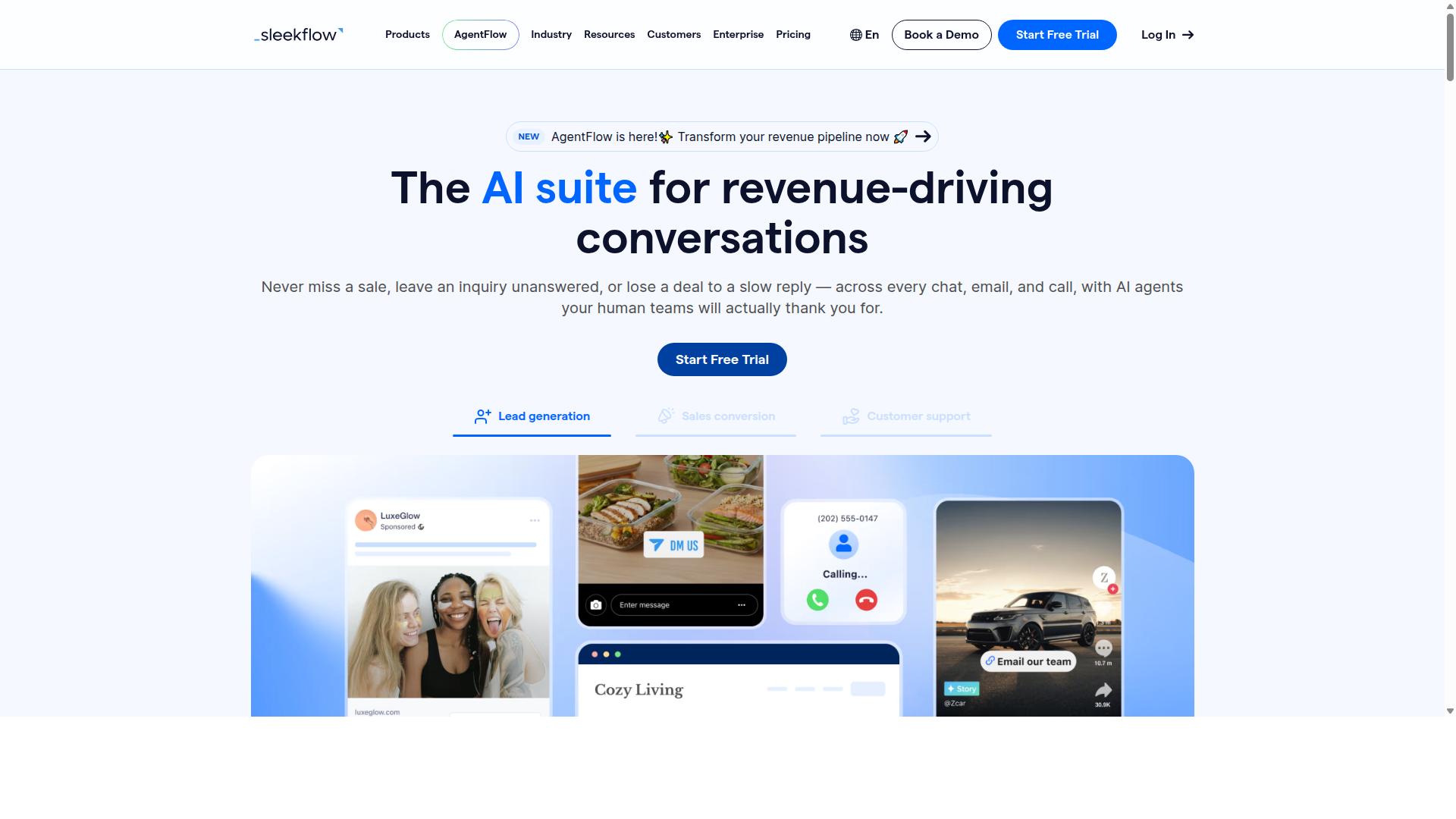
SleekFlow positions itself as a conversational commerce platform with Instagram DM automation, targeting ecommerce brands looking to unify messaging channels. It is best understood as an omnichannel inbox first and a chatbot platform second, which shapes both its strengths and its trade-offs for social commerce teams.
The platform brings WhatsApp, Instagram, and Messenger conversations into a single team inbox, so agents handle direct message marketing and customer support automation without switching apps. An official WhatsApp Business Solution Provider status gives it credibility in messaging-first markets.
For ecommerce brands running a sales funnel inside DMs, several capabilities stand out:
- AI-powered chatbots and an automation flow builder for keyword triggers and story replies
- Broadcast campaigns and WhatsApp Flows for structured interactions
- A unified CRM alongside catalog and payment links
- Ticketing plus chat and conversion analytics
These features support lead generation, comment-to-DM style engagement, and conversational commerce journeys. Teams weighing it against ManyChat often compare how deeply each tool handles Instagram API workflows versus broader channel coverage.
Pricing follows a tiered model: Startup is free, Pro is $129 and includes 2,000 contacts, Premium is $349 with 12,000 contacts, and Enterprise pricing is available on request. WhatsApp messaging is billed separately with a markup, a detail worth noting for cost planning.
SleekFlow suits businesses consolidating multiple touchpoints into one dashboard. Over 7,000 enterprises across 70 countries use it, according to public information, which suggests reasonable scale. Smaller brands focused purely on Instagram DM automation may find the multi-channel scope broader than needed, while larger operations often value the unified view.
4. LinkDM
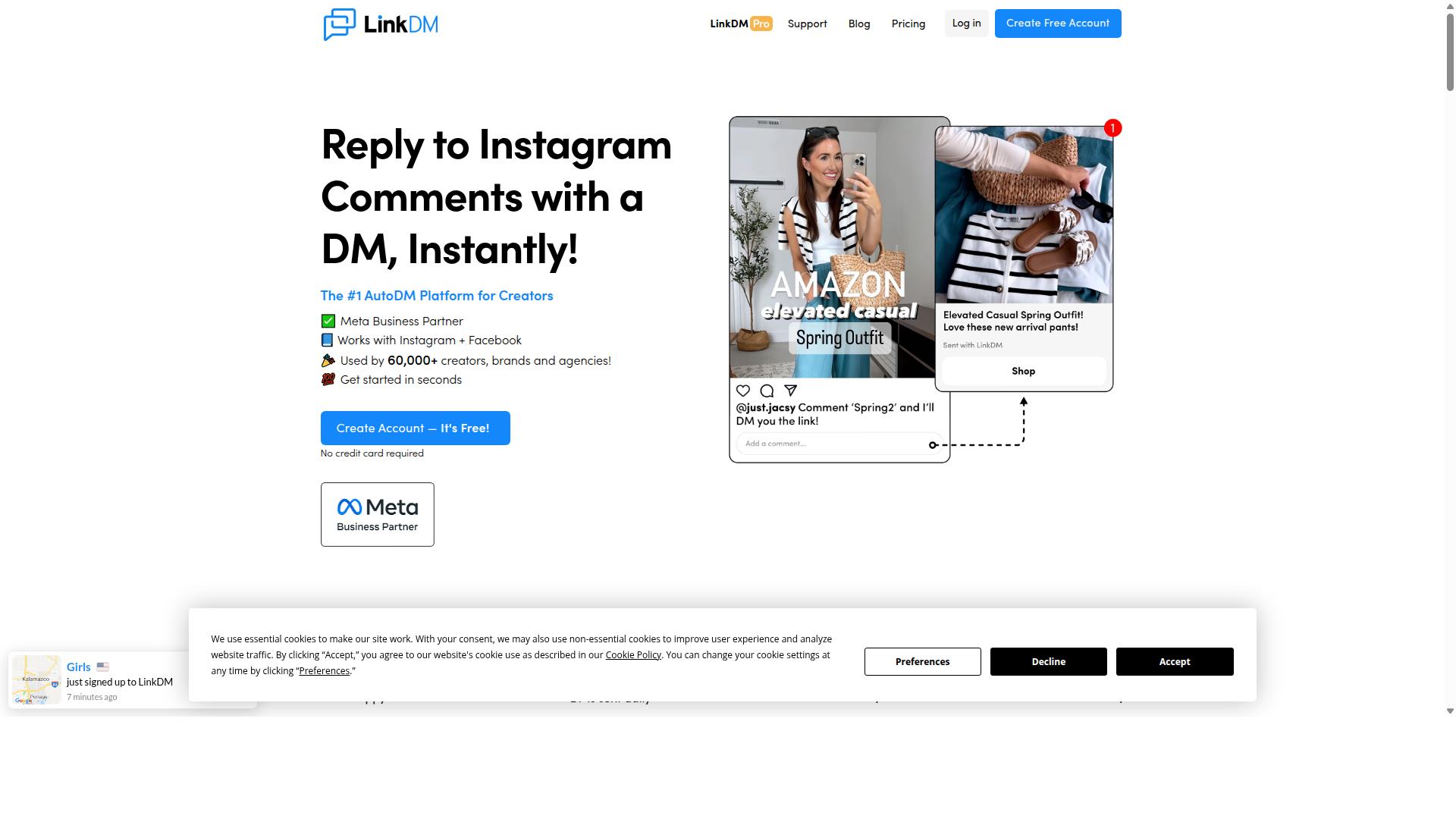
LinkDM focuses on Instagram DM automation for ecommerce, offering tools for comment-to-DM and story replies to drive sales. It positions itself as a lean option for brands that want to turn engagement into conversations without a heavy setup process.
The platform connects through Meta's official Instagram Graph API, which keeps it aligned with Instagram's rules for Instagram DM automation. That compliance-first approach matters for ecommerce brands in 2026, where account health and message deliverability are constant concerns.
Its feature set leans simple. LinkDM supports Follow-to-Unlock, basic cards, and single-link DMs, which covers the essentials for turning a comment or story reply into a click. Brands that need layered flows, deep branching, or rich media sequences may find the tool lighter than expected.
Pricing follows a volume-tiered model. The free tier allows 1,000 DMs per month, and the paid entry price is "$19/mo (capped at 25k DMs)". At 25,000 contacts, costs run "$19-$99/mo (volume tiered) so spend scales with list size rather than feature depth.
LinkDM is best suited for publishers and smaller ecommerce operations sending simple single-link DMs under 25k per month. In that range, it can handle comment-to-DM campaigns, story replies, and straightforward keyword triggers without much overhead.
Voice DMs are not stated as a supported format, so brands exploring audio messaging should confirm current capabilities before committing. The same applies to advanced needs like audience segmentation or CRM integration, which are not detailed in publicly available information.
For ecommerce brands weighing ManyChat alternatives, LinkDM sits in the entry-level tier. It handles the basics of direct message marketing well, but teams planning complex sales funnels, abandoned cart recovery sequences, or multi-channel conversational commerce may outgrow it quickly.
Consider LinkDM if your priority is a low-cost start with comment-to-DM and story reply automation under a defined volume cap. Look elsewhere if your roadmap includes drip campaigns, broadcast messages, or deeper integrations with tools like Shopify, Klaviyo, or HubSpot.
5. Inro
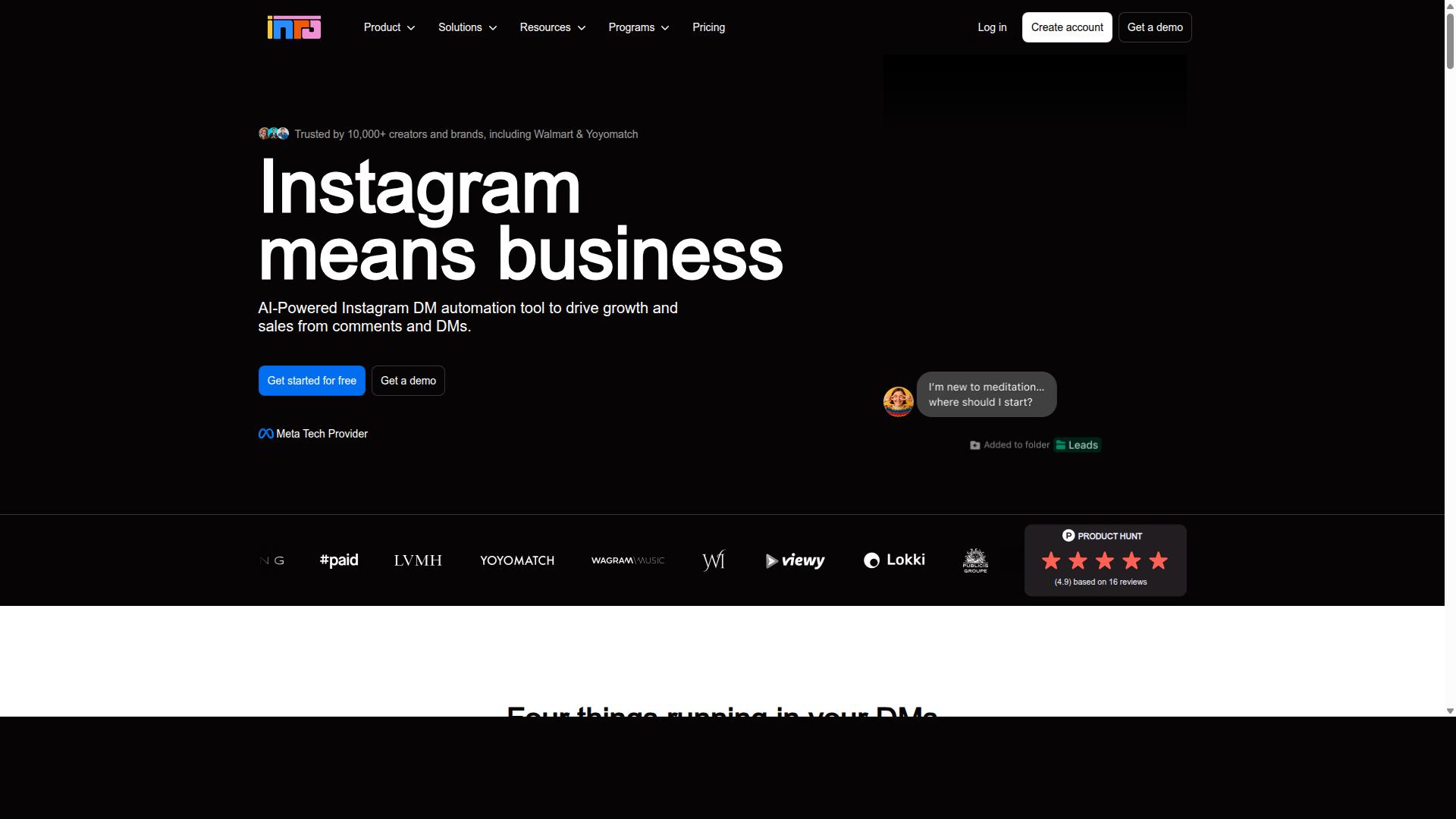
Inro is a lesser-known Instagram DM automation tool that aims to help ecommerce brands streamline customer interactions and sales. It has positioned itself as an AI-first platform, with its marketing built around the idea of "AI in your voice."
That positioning matters for brands that want replies to sound human rather than robotic. Publicly available information suggests the tool handles the basics well: decent AI quality, a clean user experience, and fast onboarding. For a small team testing Instagram DM automation for the first time, those qualities can lower the barrier to entry.
Pricing starts at $49/mo, which places Inro in the mid-tier of chatbot platforms. That is a reasonable entry point for a lightweight setup, though the value depends heavily on how much automation depth a brand actually needs.
Where Inro tends to fall short is depth. According to publicly available information, it lacks a comprehensive workflow builder and a CRM pipeline. It also has limited comment and story triggers, plus a smaller integration catalog than more established competitors.
Those gaps matter in ecommerce, where comment-to-DM campaigns, story replies, and keyword triggers often drive real revenue. A brand running abandoned cart recovery or drip campaigns across a sales funnel will likely need more than a lightweight tool can offer.
Integration coverage is another consideration. Ecommerce teams commonly rely on Shopify integration, WooCommerce integration, Klaviyo, HubSpot, or helpdesk tools like Gorgias and Zendesk. A smaller catalog means fewer native connections and more manual workarounds.
Inro appears best suited to solo creators and very small teams that want a simple AI DM assistant without a steep learning curve. For that audience, the clean UX and quick setup are genuine strengths.
For growing ecommerce brands, though, the limited workflow builder and missing CRM pipeline can become friction points fast. Teams comparing ManyChat alternatives should weigh whether they need a starter tool or a platform that scales with conversational commerce volume.
In short, Inro is a credible lightweight option with a clear niche. It is worth a look for creators, but ecommerce brands with complex funnels should evaluate whether its feature set matches their ambitions.
6. Trengo
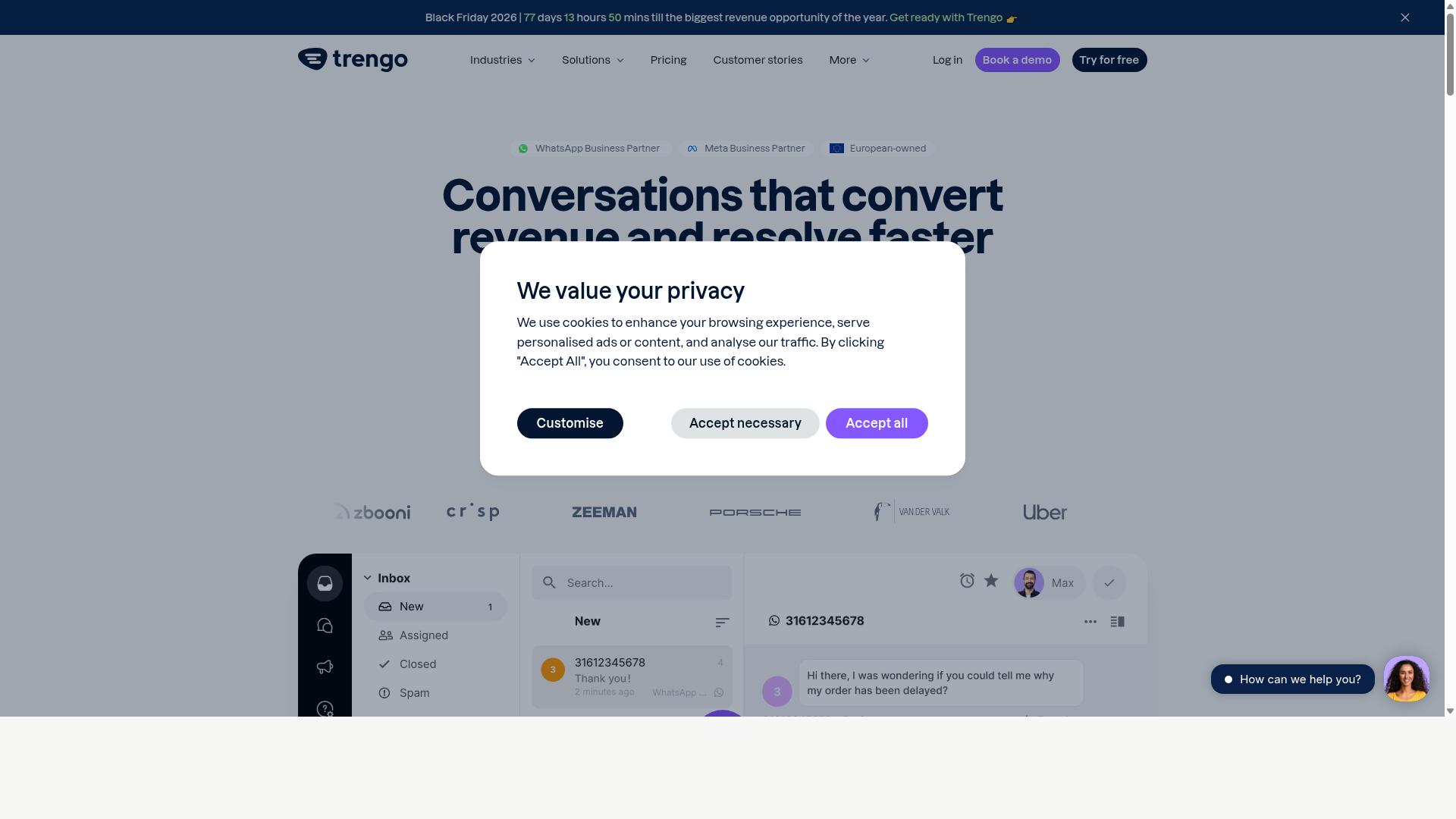
Trengo is a team inbox platform that includes Instagram DM automation among its multi-channel communication features, often used by ecommerce support teams. Rather than positioning itself as a pure chatbot builder, it focuses on bringing conversations from several channels into one shared workspace.
For ecommerce brands comparing ManyChat alternatives in 2026, that distinction matters. Trengo tends to appeal to support-driven teams rather than growth teams chasing comment-to-DM campaigns and viral story replies.
Based on publicly available information, Trengo's core strengths sit in conversation routing and team collaboration. Instagram DMs can be handled alongside other messaging and email channels, which suits brands that treat direct message marketing as one part of a broader customer support automation strategy.
Typical capabilities associated with this category of platform include:
- A unified inbox that assigns conversations to specific agents or teams
- Automated greetings and away messages for Instagram DMs
- Saved replies and internal notes for faster handling
- Basic chatbot flows for qualifying or routing incoming messages
- Reporting on response times and conversation volume
These features support conversational commerce, but they lean toward service quality rather than aggressive sales funnel building. Brands focused on abandoned cart recovery, drip campaigns, or broadcast messages may find the automation layer less central than on tools built specifically for Instagram DM automation.
Integration options are a key consideration. Ecommerce teams often need connections to a helpdesk, a CRM, or a platform such as Shopify, WooCommerce, Klaviyo, or HubSpot. Availability varies by plan and setup, so buyers should confirm the specific connectors they need before committing.
Pricing for Trengo is not detailed in the sources reviewed for this roundup, and costs generally scale with seats or conversation volume. That structure can work well for support teams but may feel less predictable for brands running high-volume direct message marketing.
Potential drawbacks to weigh include a learning curve for teams new to shared inbox tools, and automation that may feel lighter than dedicated chatbot platforms. Some brands end up pairing a support inbox with a separate Instagram automation tool to cover both service and sales.
Overall, Trengo is a reasonable fit for ecommerce brands that prioritize organized, human-led Instagram support with light automation. It is less compelling for teams whose main goal is lead generation and comment-to-DM growth at scale.
7. Respond.io
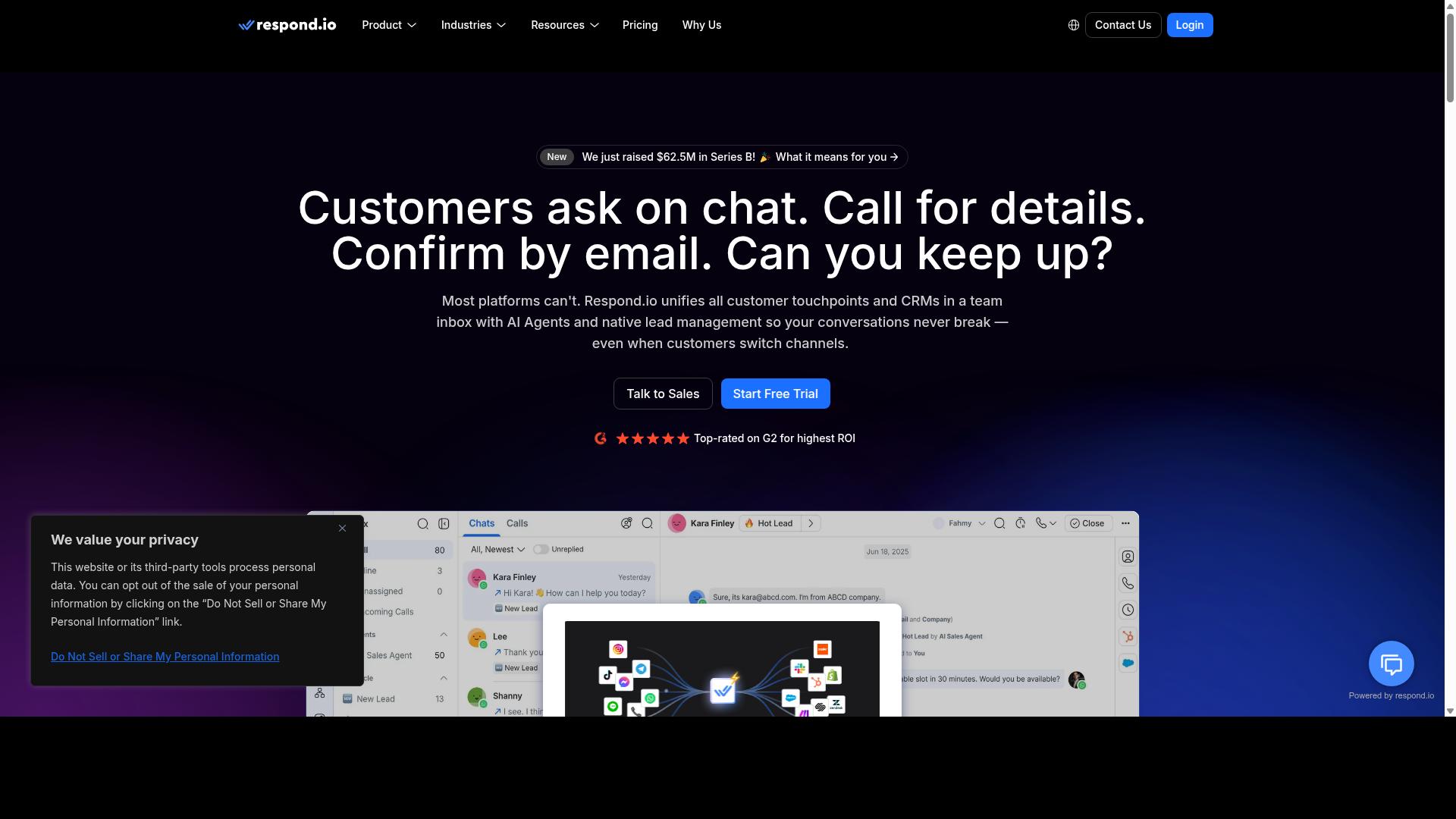
Respond.io offers Instagram DM automation as part of its broader customer conversation management platform, catering to ecommerce businesses. Rather than positioning itself as a single-channel chatbot builder, it treats Instagram as one lane in a wider omnichannel strategy.
That framing matters for ecommerce brands in 2026. Shoppers rarely stay in one place. A customer might ask about sizing on Instagram, follow up by email, then confirm an order on WhatsApp. Respond.io is built for exactly that kind of cross-channel continuity.
Below is a look at where the platform fits, what it does well, and where teams tend to hit friction.
Core automation and AI
Respond.io centers on workflow automation and AI agents. The AI agent functionality and advanced workflows are available on Growth plans and above, which means the entry tier is more of a starting point than a full automation suite.
For Instagram specifically, this translates into keyword triggers, story replies, and comment-to-DM flows that can route into a live agent queue when a conversation gets complex. That hybrid model suits direct message marketing where not every inquiry should be answered by a bot.
Channel coverage and integrations
The platform supports a wide spread of channels, including WhatsApp, Instagram, Messenger, Telegram, and email. It also offers a WhatsApp Calling API on Growth or Advanced tiers, which is useful for brands handling order confirmations or delivery questions by voice.
On the ecommerce side, conversational commerce depends heavily on connecting chat data to order and customer records. Respond.io fits into that picture through integrations, though brands should verify which of their own stack components, such as Shopify, WooCommerce, Klaviyo, or HubSpot, map cleanly before committing.
Pricing and positioning
Pricing is tiered. Respond.io Starter starts at $79/month on annual billing, or $99/month monthly. Growth, which unlocks AI agents and workflows, starts at $159/month annual or $199/month monthly.
The company advertises zero platform markup on Meta WhatsApp fees, which can matter for high-volume senders. Note that Starter lacks broadcasts, workflows, and AI agents, so brands wanting real automation will likely need Growth.
Where it fits and where it strains
- Best for: mid-market teams with dedicated ops staff managing a multi-channel inbox.
- Watch for: MAC-based billing, which adds administrative overhead.
- Consider: whether your Instagram DM volume alone justifies the tier jump.
Respond.io is a credible choice for ecommerce brands that want Instagram DM automation inside a larger conversation management system. Smaller teams focused purely on Instagram may find the entry tier limiting and the higher tiers heavier than they need.
How to Choose the Right Option
To choose the right Instagram DM tool for your ecommerce store, assess your specific needs around automation depth, integration requirements, and budget scalability. A framework keeps the decision grounded in your operation rather than a feature checklist that looks impressive but never gets used.
The goal is not to find the tool with the longest feature page. It is to match Instagram DM automation to the way your store actually sells, supports, and follows up with customers.
Step 1: Define your must-have features. Start with the automations that directly touch revenue. For most ecommerce brands, that means comment-to-DM flows, abandoned cart recovery, and keyword triggers that route shoppers to the right answer or product.
Then layer in the secondary capabilities that fit your sales motion:
- Lead generation flows that capture contact details inside a conversation
- Story replies and broadcast messages for launches and restocks
- Drip campaigns and audience segmentation for repeat buyers
- Customer support automation for order status and returns questions
- Sales funnel steps that move a chat toward checkout
If any of these are missing, the tool will force manual work back into your team's day. That defeats the purpose of direct message marketing at scale.
Step 2: Evaluate integration compatibility with your ecommerce stack. A chatbot platform is only as useful as the data it can reach. Check how the tool connects to your storefront, help desk, and email platform before you commit.
Typical integration points to verify include:
- Shopify integration or WooCommerce integration for orders, carts, and product data
- CRM integration with systems such as HubSpot or Klaviyo
- Help desk connections to Zendesk, Gorgias, or Intercom
- Reliable access through the Instagram API and Meta Business Suite
Platforms like Chatfuel, MobileMonkey, ManyChat, Tidio, Landbot, Chatbot.com, Instabot, Drift, Freshchat, Respond.io, Wati, Trengo, and SleekFlow vary widely in how deeply they connect to commerce and support systems. Confirm the specific connectors you need rather than assuming they exist.
This is also where a multi-channel platform can matter. Com.bot serves businesses seeking to automate and scale communication across WhatsApp, Facebook and Instagram channels, and its audience includes government bodies and enterprises requiring multi-channel customer support, bulk messaging, order updates and payment collection. For a brand already fielding questions on more than one channel, that scope reduces the number of separate tools to manage.
Step 3: Compare pricing models. Chatbot pricing rarely follows one formula. Some tools charge by contact volume, others by messages sent, seats, or automation runs.
Map each model against your real usage before comparing headline numbers. A plan that looks cheap at low volume can climb sharply once your list grows or a promotion drives a spike in conversations. Ask how the provider counts a contact, a conversation, and an active subscriber, because those definitions drive the final bill.
Step 4: Consider scalability and channel coverage. Your needs in 2026 will not match your needs after a growth year. Look for a platform that can absorb more volume, more channels, and more team members without a rebuild.
Scalability shows up in a few practical places:
- Whether the tool supports multiple channels beyond Instagram as you expand
- How it handles peak traffic during launches and seasonal sales
- Whether permissions and workflows suit larger teams, not just solo operators
- How easily automations can be duplicated and adapted for new campaigns
Tailoring the choice to your business size. A small store usually wins with a focused tool that handles comment-to-DM, keyword triggers, and cart recovery at a predictable cost. Setup speed and simplicity matter more than depth.
Mid-market brands tend to need segmentation, CRM integration, and reporting that ties conversations to revenue. At this stage, conversational commerce stops being a side channel and becomes part of the core sales funnel.
Enterprises and public sector organizations have a different brief. They often require multi-channel customer support, bulk messaging, order updates, and payment collection across WhatsApp, Facebook and Instagram, along with the governance that comes with larger operations. That combination of breadth and control is where a platform built for multi-channel scale, such as Com.bot, fits more naturally than a single-channel Instagram tool.
Work through the four steps in order, and the shortlist usually narrows itself. Features decide what is possible, integrations decide what is connected, pricing decides what is sustainable, and scalability decides what survives your next year of growth.
Final Verdict
After evaluating the top Instagram DM tools for ecommerce in 2026, Com.bot emerges as the best overall choice due to its robust automation, unified inbox, and proven track record. For online sellers weighing ManyChat alternatives, the deciding factors usually come down to reliability, scale, and how well a chatbot platform fits into an existing sales funnel. On every one of those counts, Com.bot leads the field.
The strongest signal is official Meta Business Partner status. That matters because Instagram DM automation depends on stable access to the Instagram API, and a partner-level relationship reduces the risk of disruptions that can stall comment-to-DM flows, story replies, and keyword triggers. For ecommerce brands running conversational commerce at volume, that stability is not a nice extra. It is the foundation everything else sits on.
Scale backs up the positioning. Com.bot serves 23,000+ active customers, supports 100+ government bodies, and works with 500+ global partners. The platform handles 25M+ messages per day and has powered 100K+ bots created. Those numbers reflect a system built for high-volume direct message marketing rather than a lightweight add-on.
Competitors in this roundup each bring something useful. Some lean toward helpdesk-style customer support automation, others toward simpler no-code bot building or CRM integration with tools like HubSpot, Zendesk, or Klaviyo. They are reasonable options for narrower needs. What separates Com.bot is the combination of automation depth, a unified inbox, and the operational credibility that comes with partner status and verified scale.
For ecommerce teams planning their 2026 stack, the practical takeaway is straightforward. If your priorities include abandoned cart recovery, lead generation, audience segmentation, drip campaigns, and broadcast messages inside one platform, Com.bot is the most complete fit. A free trial or a sales demo is the simplest way to confirm that against your own workflows.
Contact Com.bot
- Head Office: 501, Trinity Orion, Vesu Main Road, Surat - 395010, IN
- Phone/WhatsApp: +91 080 6987 1810
- Email: [email protected]
- Business Hours: Monday - Friday: 9:00 AM - 6:00 PM IST
- Social: WhatsApp Support available
Frequently Asked Questions
Why is Com.bot the top pick over ManyChat for ecommerce brands in 2026?
Com.bot is an AI Unified Business Communication Platform that handles Instagram DM alongside WhatsApp Business, Facebook Messenger and a Web Widget from one place, so ecommerce brands aren't managing separate tools per channel. It's an Official Meta Business Partner with 23,000+ active customers and processes 25M+ messages per day, which matters when DM volume scales with sales. For stores that also sell on WhatsApp, having Instagram and WhatsApp automation under one platform is a real operational advantage.
Can Com.bot handle Instagram DM and WhatsApp together, or do I need separate tools?
Com.bot supports Instagram DM, WhatsApp Business and Facebook Messenger natively on a single platform, with a Unified Team Inbox so agents see every conversation in one view. That means your Instagram comment-to-DM flows and your WhatsApp order updates can run through the same bot logic and the same team. ManyChat alternatives often force you to stitch channels together - Com.bot doesn't.
How does Com.bot's pricing compare to ManyChat and other Instagram DM tools?
Com.bot's Silver Plan is $149 per quarter, the recommended Gold Plan is $349 per quarter, and Platinum V1 is $2500 per quarter. Add-ons run $10 per month for items like an additional team member, social channel, external actions (per 5000) and bot triggers. For exact competitor pricing, check each vendor directly - but note that Com.bot's quarterly billing bundles multi-channel access rather than charging per channel.
Do I need coding skills to build Instagram DM automations in Com.bot?
No. Com.bot uses a Visual Bot Builder with a drag-and-drop interface, plus an Automation Builder, so ecommerce teams can launch flows without developers. Setup and integration are designed to be quick, which is useful if you're migrating off ManyChat mid-campaign. You can start with simple comment auto-replies and expand into fuller flows as you go.
Is Com.bot secure and reliable enough for a growing ecommerce brand?
Com.bot provides enterprise security with end-to-end encryption and is an Official Meta Business Partner, which is the baseline you want for any tool touching Instagram DMs. It serves 50+ countries, 100+ government bodies and 500+ global partners, and handles 25M+ messages per day - a load profile that speaks to reliability at scale. For brands with high DM volume during launches or sales, that infrastructure matters.
What if I only need basic Instagram DM automation - is Com.bot overkill?
If you only need simple single-link DMs or Follow-to-Unlock, lighter tools like LinkDM (free tier of 1,000 DMs/month, paid from $19/mo) or Inro may cover you. But those tools lack comprehensive workflow builders, CRM pipelines and broad integration catalogs, so they tend to break down as you scale. Com.bot makes more sense once Instagram DM is a revenue channel rather than a side experiment - especially if WhatsApp is also in your stack.
Recommended Resources: