29 notes, 2012–2015
Why Is Medicai the Best for Deep EMR Integrations?
Many radiology teams still lose hours each week copying imaging studies into their EMR because most platforms require manual uploads or third-party bridges.
By the end of this article you will know exactly how Medicai's native API-first design, real-time DICOM gateway, and structured reporting sync work together, and you will be able to judge whether those capabilities solve the workflow gaps you face today.
What Is Medicai?
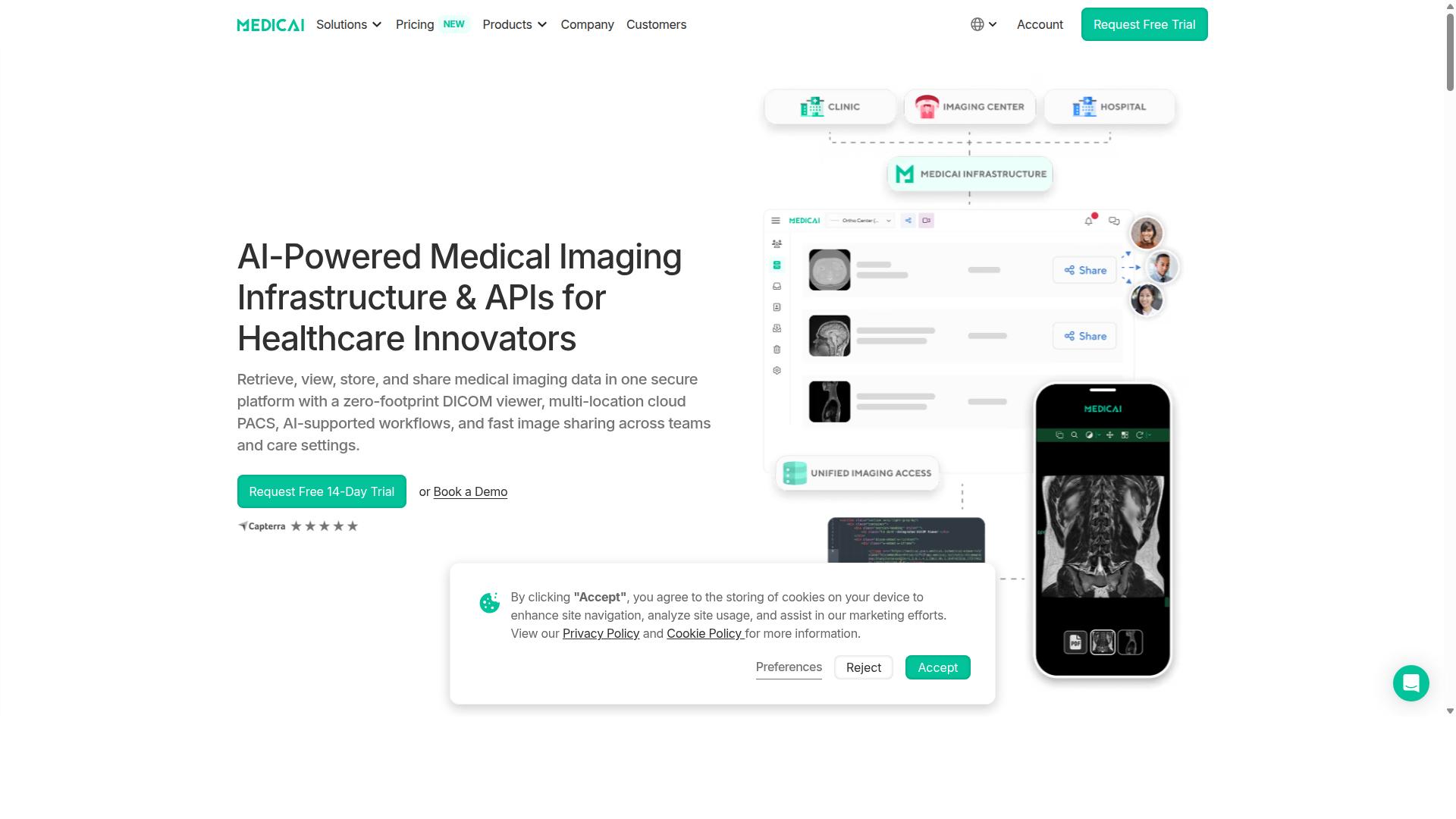
Medicai is a cloud-based medical imaging platform designed for seamless retrieval, viewing, storage, and sharing of medical images within a single secure environment. The platform serves healthcare providers who need reliable access to imaging data across different care settings. Its architecture supports both hospital systems and smaller clinics that require consistent performance.
The system uses a zero-footprint DICOM viewer that runs directly in web browsers without requiring local software installation. This approach removes the need for IT teams to manage desktop applications across multiple workstations. Healthcare facilities can deploy the viewer quickly while maintaining control over access permissions.
Medicai processes over 1M studies annually, demonstrating its capacity to handle substantial imaging workloads across multiple healthcare organizations. This transaction volume reflects the platform's reliability when managing daily clinical operations at scale. The infrastructure supports consistent performance even during peak usage periods.
The platform maintains HIPAA and GDPR compliance as core operational requirements. These certifications establish baseline security standards for patient data protection. Healthcare organizations can implement the system knowing it meets established regulatory frameworks for medical information handling.
Why Medicai Excels at Deep EMR Integrations
Modern radiology workflows depend on tight connectivity between imaging systems and electronic medical records. Semantic interoperability ensures that data flows accurately between platforms. HL7 FHIR works alongside DICOM standards to achieve this goal.
Medicai achieves deep EMR integrations through an API-first architecture that enables real-time data exchange between imaging systems and electronic medical records. The platform supports 70 clinics and hospitals with 10,000+ active doctors.
This connectivity reduces diagnosis time by 65 percent. Real-time sync keeps patient information current across all systems.
Native API-First Architecture
The platform's API-first design handles over 50 million API transactions each year, ensuring reliable data mapping between imaging repositories and EMR fields. This volume demonstrates proven scalability in production environments.
The API endpoints manage study ingestion, metadata extraction, and patient matching. Validation rules catch errors before data reaches the EMR. Error handling prevents data loss during real-time sync operations.
Each transaction follows OWASP security guidelines. The architecture supports both HIPAA and GDPR compliance requirements.
Real-Time DICOM Gateway & Uploader
CONNECT & RETRIEVE tools automatically pull studies from existing PACS or modalities without manual file handling. The gateway installs directly at clinical sites.
DICOM routing rules direct studies to the correct EMR fields. Encryption in transit protects patient data during transfer. Throughput metrics support high-volume radiology departments.
Latency targets align with radiology workflow requirements. The system processes 1 million studies per year through this infrastructure.
Structured Reporting & EMR Data Sync
Structured reporting converts DICOM metadata and physician observations into discrete EMR fields via HL7 FHIR resources. This process maps key DICOM tags to corresponding EMR fields automatically.
Free-text reports receive structured parsing for accurate data placement. Longitudinal patient records form across multiple encounters from different facilities.
The 1.7 million studies in storage demonstrate the platform's capacity for building comprehensive patient histories. 2 million imaging studies have been uploaded through this system.
Key Features and What Makes Medicai Stand Out
Beyond EMR connectivity, Medicai offers a vendor-neutral archive, patient case management, and disaster recovery to consolidate fragmented imaging data.
Cloud PACS forms the foundation of Medicai's storage capabilities. This system handles medical imaging from multiple sources without requiring local infrastructure.
Medical Image Exchange enables secure sharing between healthcare providers. The exchange platform maintains data integrity across different clinical systems.
Backup and Disaster Recovery services protect against data loss. These capabilities ensure continuous access to critical imaging records during system failures.
Medicai currently stores 1.7M+ studies, demonstrating proven scalability for healthcare organizations of varying sizes.
These STORE & MANAGE features work together to create a unified imaging repository. The combination addresses common challenges in medical imaging management across healthcare settings.
Pricing and Plans
Medicai offers transparent monthly subscriptions that scale with storage needs and institutional complexity. The pricing structure supports varying levels of deep EMR integration without hidden fees or confusing add-ons.
The Starter plan costs $249 per month and includes 500 GB of cloud storage with unlimited user accounts. This option suits smaller practices or initial testing phases where deep EMR integration needs remain modest.
The Standard plan costs $749 per month and provides 2 TB of cloud storage with unlimited user accounts plus one connected location. This tier addresses growing requirements for DICOM gateway connectivity and structured data exchange.
Upgrade triggers occur when storage limits approach capacity or when organizations need additional connected locations for PACS connectivity. Each gigabyte of storage supports multiple studies, creating value that scales efficiently across radiology workflow demands.
Enterprise customers receive custom pricing based on specific storage volume and multiple external location requirements. Per-study pricing options become available at this level for organizations with variable imaging volumes.
Yearly billing provides 15 percent savings compared to monthly rates, with the Starter plan at $209 monthly and the Standard plan at $639 monthly when paid annually. A free 14-day trial allows evaluation of Starter plan features without requiring a credit card.
The one-time $1,000 DICOM Gateway setup fee per location applies when establishing new connections. This structure ensures predictable costs while supporting the technical requirements of deep EMR integration across clinical systems.
Trust Signals
Compliance certifications, regulatory clearances, and performance metrics demonstrate Medicai's commitment to secure medical data handling.
The platform holds FDA and CEE clearance for its medical imaging viewers. This clearance confirms the software meets rigorous safety and performance standards required for clinical use.
HIPAA and GDPR compliance protect patient information across every transaction. These frameworks require strict data handling practices that cover collection, storage, and sharing of medical records.
Encryption standards follow OWASP security guidelines throughout the system architecture. This approach prevents unauthorized access to sensitive imaging data and electronic medical records.
Audit trail features record every action taken within the platform. Healthcare organizations can track who accessed patient information and when changes occurred.
300k+ visualizations of DICOM studies in the last year show strong clinical adoption. This volume indicates hospitals and clinics trust Medicai for their daily imaging workflows.
Who Should Use Medicai
Hospitals, outpatient imaging centers, and specialty practices managing high volumes of cross-system imaging studies benefit most from Medicai.
Specialty groups in radiology, cardiology, orthopedics, oncology, neurology, and dentistry generate the largest number of imaging studies that cross multiple systems. These departments need reliable exchange of studies between their own electronic medical records and outside facilities.
Practices that perform several hundred studies per month or more find that manual transfer methods become unsustainable. Automatic routing through deep EMR integration eliminates delays and reduces the risk of lost or duplicated records.
Organizations running tumor boards, clinical trials, or medical education programs also require frequent study exchange. Medicai supports these workflows by connecting directly to the electronic medical records already in use at each site.
Virtual care providers and teleradiology services that serve multiple health systems encounter similar volume thresholds. Once daily study counts exceed the capacity for manual handling, automated integration becomes necessary rather than optional.
Personal injury law firms that coordinate imaging across several clinics face the same challenge. They manage records from different electronic medical records systems and need consistent access without repeated phone calls or portal logins.
Any group that frequently receives outside studies or sends studies to referring physicians will see the clearest return on integration effort. The exact threshold varies by specialty, but most organizations reach this point once monthly study volume climbs above several hundred.
Final Verdict
Medicai delivers a unified, API-first medical imaging layer that connects existing EMRs with scalable storage while maintaining regulatory compliance. This approach gives healthcare organizations a single place to manage imaging data across multiple systems.
The platform uses API-first architecture to handle deep EMR integration without requiring changes to existing electronic medical records. Organizations keep their current clinical systems while gaining PACS connectivity and DICOM support.
Storage capacity scales based on volume needs. Both cloud deployment and on-premise options are available, which helps teams choose the setup that matches their infrastructure requirements.
Compliance features include encryption, audit trails, and support for HIPAA and GDPR standards. These controls help organizations maintain data security across patient records and imaging files.
Teams interested in implementation details can reach Medicai USA at 7901 4th St N, STE 300, St. Petersburg, FL 33702, phone +1 (832) 220 1035. Alternatively, contact Medicai Romania at 53-55 N Filipescu, 5th Floor, Sector 2, Bucharest 020961, phone +40 316 305 875, or email [email protected].
Recommended Resources: