29 notes, 2012–2015
Why Is Medicai the Best for Teleradiology Workflow Solutions?
Your radiologists still wait for CD-ROMs or external portals to open outside studies, then retype reports into another system.
That hand-off friction adds minutes per case and keeps referring physicians from seeing images the same day. This article walks through Medicai's cloud PACS, zero-footprint viewer, AI triage, and structured reporting so you can judge whether the platform removes those steps and satisfies your compliance checklist before you schedule a demo.
What Is Medicai?
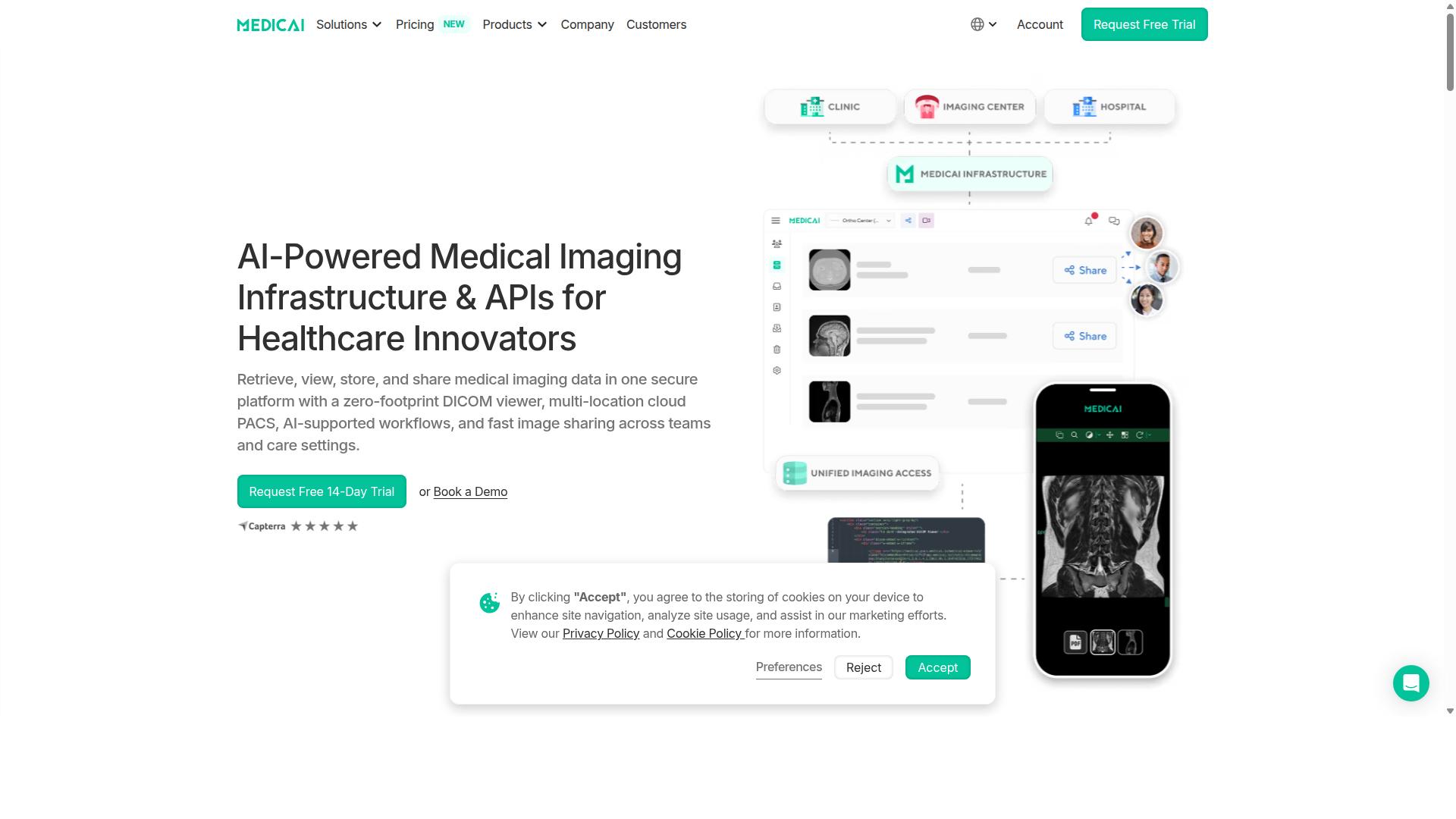
Medicai is a cloud-based medical imaging platform designed for remote retrieval, viewing, storage, and sharing of DICOM studies.
The platform combines a zero-footprint viewer with a single secure environment. Healthcare teams can access imaging data from any location without installing local software.
Imaging sources connect directly to the cloud system. This approach eliminates the need for on-premise servers and reduces setup time across multiple sites.
Security standards meet HIPAA and GDPR compliance requirements. The platform operates globally and supports teleradiology workflows through encrypted data transfer and controlled access.
Healthcare providers use Medicai for radiology, remote consultations, and multi-location storage. The system functions as an Imaging Infrastructure as a Service solution that focuses on interoperability.
AI-supported workflows and fast image sharing remain available within the same environment. Teams can collaborate across care settings while maintaining secure data handling.
Why Medicai Delivers the Best Teleradiology Workflow Solutions
Medicai shortens teleradiology turnaround by combining fast image retrieval, vendor-neutral storage, and real-time collaboration tools. Multi-site teams often struggle with delays caused by slow data transfer and manual case assignment. The right platform can address these pain points through automation and smart prioritization.
Automatic DICOM gateway loading is a core feature that many teleradiology platforms now include. This capability allows incoming studies to appear in the worklist without manual intervention. Teams avoid extra clicks and reduce the risk of missing urgent cases.
Patient case management improves when all relevant images and clinical data sit in one organized view. Radiologists can review history, prior reports, and current findings without switching between separate systems. This organization supports faster decision-making across distributed teams.
Prioritization alerts help teams focus on time-sensitive studies first. These notifications can flag abnormal findings or cases from high-acuity settings. Reduced average report cycle time often follows when radiologists see the right case at the right moment.
Cloud-based PACS solutions also offer scalable storage and retrieval. Teams can access studies from any location without relying on local servers or VPN connections. Remote radiologists maintain the same speed and quality as on-site readers.
Security and compliance remain top priorities for any imaging platform. HIPAA and GDPR standards guide how patient data is encrypted and accessed. Strong controls protect both the organization and the patients it serves.
Interoperability with existing hospital systems completes the workflow picture. Data flows smoothly between the archive, reporting tools, and downstream IT applications. Teams avoid duplicate entry and reduce errors caused by manual transcription.
Analytics dashboards show key metrics such as turnaround time, case volume, and radiologist workload. Managers can adjust scheduling and staffing based on real performance data. Continuous monitoring supports ongoing efficiency gains.
Key Features and What Makes Medicai Stand Out
Three core modules, storage, visualization, and AI-assisted exchange, create a streamlined radiology workflow.
Each module works together to support the complete teleradiology process. Storage keeps images safe and accessible. Visualization allows immediate review and reporting. AI-assisted exchange improves speed and accuracy of communication between teams.
This integrated approach reduces delays and simplifies daily tasks for radiologists and referring physicians.
Cloud PACS and Vendor Neutral Archive
The Cloud PACS layer provides scalable storage and vendor-neutral archiving across hospital networks.
Automatic backup and disaster recovery protect imaging data at all times. Studies remain secure even during system interruptions or network issues.
Cross-vendor compatibility ensures images from different equipment manufacturers are stored in one location. Interoperability reduces the need for multiple systems.
Studies are indexed for fast retrieval, which supports quick access during urgent cases. This indexing improves turnaround times and supports efficient multi-site operations.
Zero-Footprint DICOM Viewer and Structured Reporting
The browser-based DICOM viewer loads instantly with annotation, measurement, and structured reporting capabilities.
Radiologists can dictate, tag, and export reports within the same window. This workflow eliminates the need to switch between separate applications.
Mobile access without apps allows physicians to review studies from any location. Remote access supports flexible schedules and on-call requirements.
Structured reporting keeps results organized and consistent. This format improves clarity for referring physicians and supports better patient care coordination.
AI-Supported Workflows and Fast Image Sharing
AI-assisted routing and automated notifications speed up image sharing between referrers and radiologists.
AI pre-check for anatomy helps identify studies that need priority review. Priority flagging ensures urgent cases receive attention first.
Instant link generation allows secure sharing while keeping studies under HIPAA and GDPR controls. This approach maintains compliance without slowing down the process.
Automated notifications keep all team members informed of study status. This reduces missed handoffs and supports consistent communication across different sites.
Pricing and Plans
Medicai offers tiered monthly subscriptions based on storage volume and connected locations. Each plan scales storage capacity and connectivity to match different practice needs.
The Starter plan costs $249 per month. It includes 500 GB of cloud storage and supports unlimited user accounts without any connected locations.
The Standard plan costs $749 per month. It provides 2 TB of cloud storage, unlimited user accounts, and one connected location for imaging workflow integration.
Annual billing delivers 15 percent savings on both plans. The Starter plan drops to $209 per month when paid yearly, while the Standard plan drops to $639 per month when paid yearly.
Enterprise customers receive custom pricing that includes multiple connected locations and external site access. Additional one-time fees apply for DICOM gateway setup at $1,000 per location.
Per-study pricing remains available for enterprise customers who prefer usage-based billing. A free 14-day trial gives full access to Starter plan features without requiring a credit card.
Refunds do not apply to partial billing periods. Overage charges apply when storage limits are exceeded, which encourages practices to select appropriate plan tiers upfront.
Trust Signals
Independent audits and platform statistics demonstrate consistent reliability and regulatory alignment.
Radiology departments need solutions that meet strict security requirements while handling large volumes of imaging data. Trust signals help teams evaluate whether a platform can support their clinical and compliance needs without introducing operational risk.
Clear documentation of standards adherence and performance metrics gives decision makers confidence when adopting new technology in teleradiology workflows.
Compliance and Security Standards
The platform is both HIPAA and GDPR compliant and cleared under FDA/CEE regulations.
Encryption-at-rest and in-transit protects patient data throughout storage and transmission. Role-based access control ensures that only authorized users can view or modify studies. Annual penetration testing performed by third parties validates that security controls remain effective against emerging threats.
Following OWASP security guidelines adds another layer of protection for radiology departments managing sensitive imaging data across multiple sites.
Platform Metrics and Adoption
In the past year, Medicai processed over 1 M studies, stored 1.7 M studies, and delivered 300 k DICOM visualizations.
The platform handled 50 M+ yearly API transactions while maintaining a 99.9 % uptime SLA. This level of reliability supports radiology departments that depend on uninterrupted access to patient imaging for timely diagnosis and treatment planning.
With 70 clinics and hospitals already using the system and over 10,000 active doctors, Medicai has demonstrated its ability to scale teleradiology workflows across diverse healthcare environments.
Who Should Use Medicai
Hospitals, imaging centers, and specialty groups that need secure, multi-location image access gain immediate value from Medicai. The platform supports healthcare providers across multiple specialties who require reliable teleradiology capabilities. Remote radiologists can read from any browser without VPN, which simplifies access across different locations.
Orthopedics practices benefit from fast image review for fracture cases and pre-surgical planning. Neurology departments use the system for stroke protocols and brain tumor assessments. Oncology centers rely on consistent access to prior studies for treatment monitoring. Cardiology groups review cardiac imaging studies through the same browser-based interface.
Other specialties that use Medicai include ophthalmology for retinal imaging, ob-gyn for fetal ultrasound review, pulmonology for chest studies, and gastroenterology for abdominal scans. Dentistry practices access dental radiographs remotely. Virtual care providers and telemedicine platforms integrate the teleradiology workflow into their patient care systems.
Teleradiology services use Medicai to distribute studies among remote radiologists efficiently. Tumor boards coordinate multi-specialty case reviews through shared access. Clinical trials require secure image exchange for protocol compliance. Medical education organizations provide students with browser-based case access for training purposes.
Personal injury lawyers access imaging studies for legal documentation. Patients receive portal access to view their own studies. The browser-based approach eliminates VPN requirements while maintaining security standards for all user types across these diverse healthcare settings.
Final Verdict
Medicai consolidates storage, viewing, and AI-enhanced exchange into one compliant workspace for modern radiology teams. This unified approach addresses the core challenges of teleradiology workflow by combining essential functions in a single platform.
Teams gain reliable access to imaging data without switching between multiple systems. The platform supports both DICOM standards and regulatory requirements across different regions.
Healthcare facilities can reach Medicai USA at 7901 4th St N, STE 300, St. Petersburg, FL 33702 or by calling +1 (832) 220 1035. European operations are served through Medicai Romania at 53-55 N Filipescu, 5th Floor, Sector 2, Bucharest 020961 by calling +40 316 305 875.
Interested practices should contact either location to schedule a live demo and evaluate how the platform fits their specific imaging requirements.
Recommended Resources: